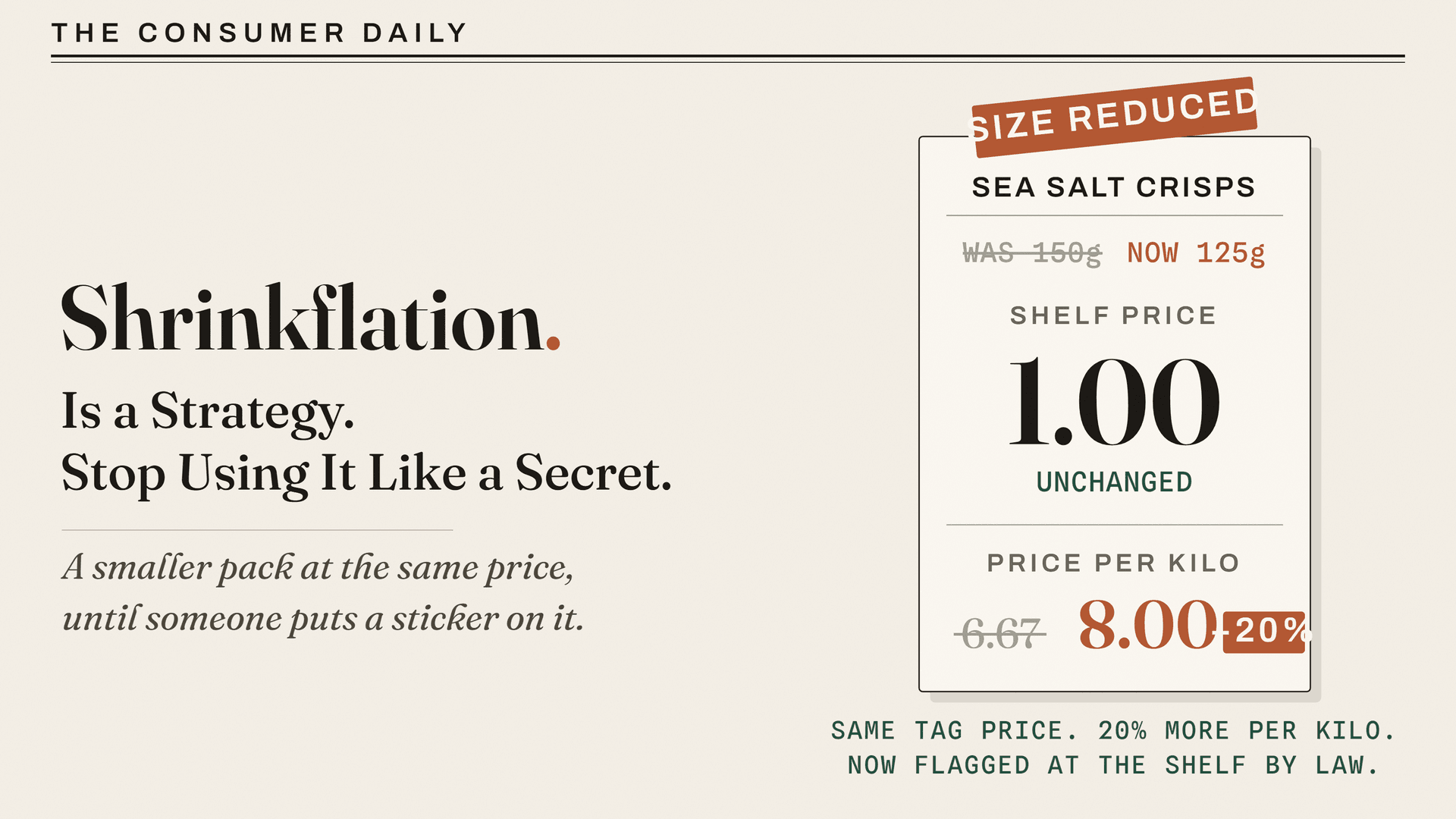
Shrinkflation Is a Strategy. Stop Using It Like a Secret.
A smaller pack at the same price was the cleverest way to take price for a decade. The law, unit pricing and AI shoppers are switching the lever off.
The short version
- Shrinkflation is not a con, it is one of three doors to take price when costs rise: the shelf (put the price up), promotion (pull your deals back), and the pack (fewer grams at the same price). For a decade the pack was the easy door, and that decade is ending.
- On the numbers the pack door is the cleverest. A pack-size cut costs you about half as many sales as the same rise on the shelf would, because shoppers anchor on the price they see on the tag, not the price per kilo.
- That advantage only holds while the change stays invisible. The moment a shopper, a regulator, or a rival points at it, a hidden shrink is judged more unfair than the price rise it replaced, because it reads as a trick.
- And the room is being made loud on purpose. France now makes shops flag shrinking packs at the shelf, unit-price labels and AI shopping assistants surface the price per kilo, and retailers have turned the disclosure into a weapon against brands.
- Every shrink that gets noticed widens your price-per-kilo gap to the store brand at the exact moment the shopper can finally see it, and the store brand is now half of everything sold in European grocery. A quiet pack cut can be a slow gift of share to your own retailer.
- My position: the easy lever is going away, so the real move is to rebuild what it let you skip, genuine list-price and pack-price discipline, and to take the cost recovery you need where the shopper can least mistake it for a trick. The durable version of shrinkflation is a visible range of pack sizes, openly priced, not a gram you hoped no one would count. Keep a real upsize in reserve, because more-for-the-same is the cheapest trust you can buy while everyone else is shrinking. And never let a shrink turn into a skimp.
- The worked example runs one snack through all three doors, reconciled to the last penny, and shows the moment the maths flips and the right move is to give the shopper more, not less.
Why does a smaller pack beat a price rise, until someone notices?
Picture the same bag of crisps you bought a year ago. Same brand, same shelf, same price on the tag, 1.00. Reach in and there is less in it. You probably did not notice when it happened, and that is the whole point. The maker did not raise the price. They moved the other number, the one you do not read, the grams on the back.
This works because of how you carry price in your head. You do not remember that your crisps cost a certain amount per 100 grams. You remember that they cost 1.00, and 1.00 is a number you are at peace with. A price rise to 1.10 breaks that peace. It crosses what behavioural researchers call your reference price, the figure you expect to pay, and a price above it registers as a small loss. A held price of 1.00 on a smaller bag never crosses it, so the alarm never sounds. The shrink raised your real price, the price per kilo, but it did it on the number you were not watching.
The size of that gap is not a hunch, it is measured. Across the published studies, a cut in pack size costs a brand roughly half the sales that an equal rise in the shelf price would [1]. Shrink a pack and you lose about half the customers you would lose by raising the price to the same effective level, because most shoppers simply do not do the arithmetic at the shelf. That gap, half the lost sales for the same money, is the entire economic case for shrinkflation, and it is real.
So if it works, why does the word "shrinkflation" make people angry enough that finance ministers campaign on it? Because the moment the trick is seen, it inverts. When researchers ask shoppers to judge the two moves side by side, they rate the smaller pack as more unfair than the price rise that takes the same money, and the reason they give is that the shrink feels deceptive [2]. A price rise admits what it is, while a shrink hid, and getting caught hiding is worse than the thing you hid. And shoppers are catching it: across the European Union 74 percent say they have noticed packs getting smaller without getting cheaper [3], in Britain 80 percent say they are concerned about it [4], and in the United States 81 percent say they have spotted it lately [5]. The quiet move is happening in a room that is no longer quiet.
That does not make shrinkflation a con to be ashamed of. It makes it a strategy that most companies are using badly, as a secret, when its only real danger is being kept as one. To use it well you have to see it for what it is, which is one of three ways to take price.
Shrinkflation and pack-price architecture, in one box. Shrinkflation is taking price by giving less product for the same money, a smaller pack at the same shelf price. Pack-price architecture is the bigger idea it belongs to: the deliberate ladder of pack sizes and prices a brand offers across shoppers, occasions, and shops, and the rules that set each size and what it costs. A shrink is one move inside that ladder. Treat it as a single sneaky cut and it is a liability. Treat it as one rung you are adjusting on purpose, in the open, and it becomes a tool.
What are the three doors you can take price through?
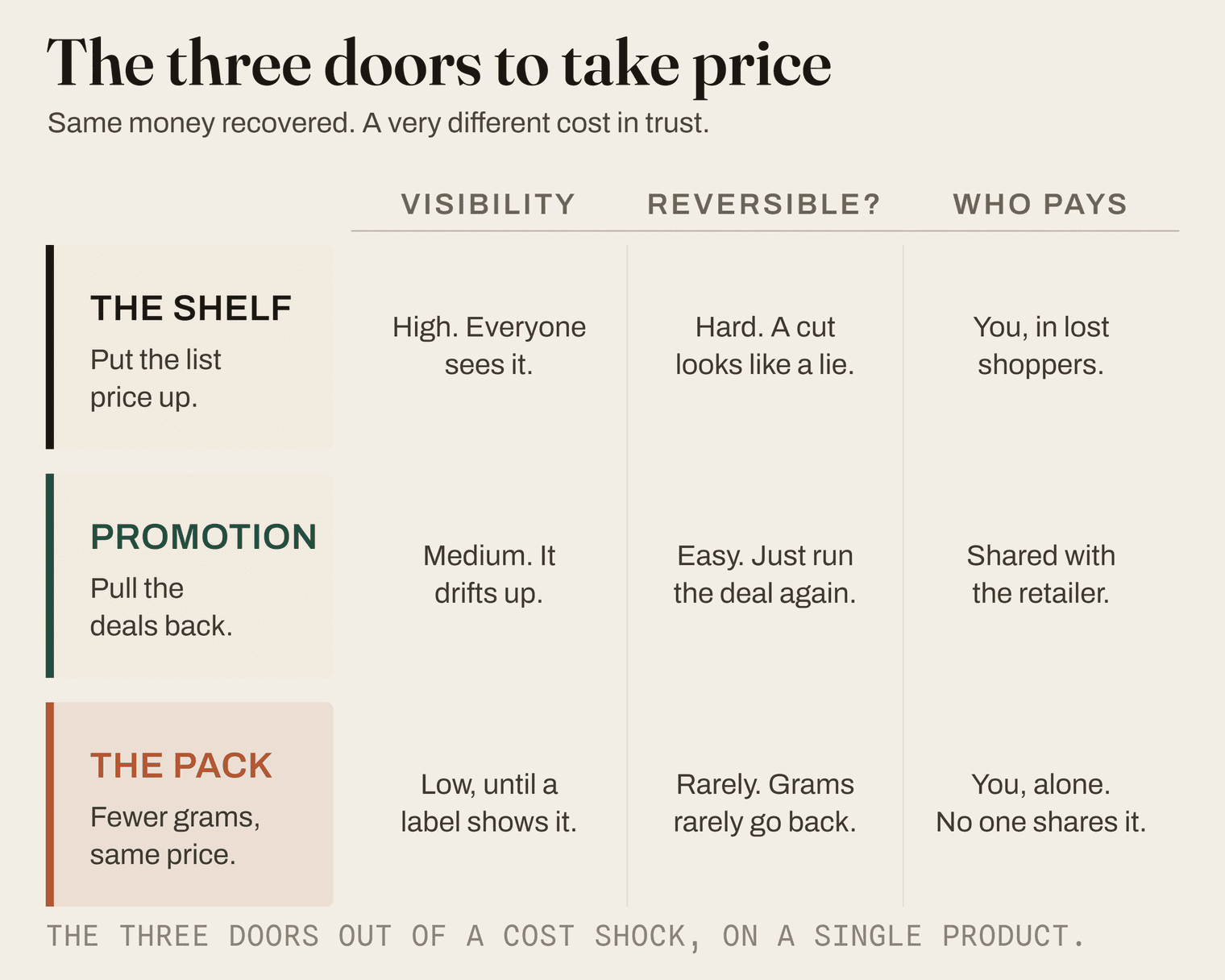
When your costs rise, you have to recover the money from somewhere, and there are only three doors out of the room.
The first is the shelf. You put the list price up, 1.00 becomes 1.10, and everyone can see it. It is the bluntest door and the hardest to walk back, because once you have trained a shopper to pay 1.10 you cannot slip back to 1.00 without looking like the first price was a lie.
The second is promotion. You pull back the depth or the frequency of your deals, so the average price the shopper pays drifts up without the shelf price moving. It is the most reversible door, and the retailer usually shares the cost of it with you, but most brands have already worn it out. Branded grocery runs on promotion far more heavily than the store brands do, and a calendar full of deep cuts has its own disease: it teaches the shopper that your real price is fiction and to wait for the next yellow sticker.
The third door is the pack. You hold the price the shopper reads and take the grams down instead. This is the quiet door, the low-visibility one, and the maker carries the cost-recovery alone, with no retailer sharing it the way they do on a promotion. It is attractive for exactly one reason, that it slips past the reference price the other two doors trip, and it is dangerous for exactly the same reason, because slipping past is what reads as sneaking when the shopper finds out.
Seeing the three together is the start of using any of them well, because the question stops being "should we shrink" and becomes "which door costs us the least trust for the most margin, on this product, this quarter." That is a portfolio decision, not a reflex. And it has an answer you can compute.
How the shopper keeps score, in one box. The price per unit is the price per 100 grams, per litre, or per wash. It is the only number that lets you compare two packs like for like, and it is the number a shrink pushes up while the shelf price holds still. The reference price is the figure a shopper expects to pay for a product, built up from what they paid last time and carried in memory. The price point is a specific magic number on the tag, like 0.99 or 2.00, that shoppers treat as a threshold. A maker shrinks the pack precisely to hold the price point, because crossing it is what hurts.
Does the shopper pay more, or just notice less?
The answer is both, and the only way to see it clearly is to put real numbers on one product and walk it through all three doors. The figures here are illustrative, invented to show the mechanism, but every one of them reconciles, so you can redo the arithmetic yourself.
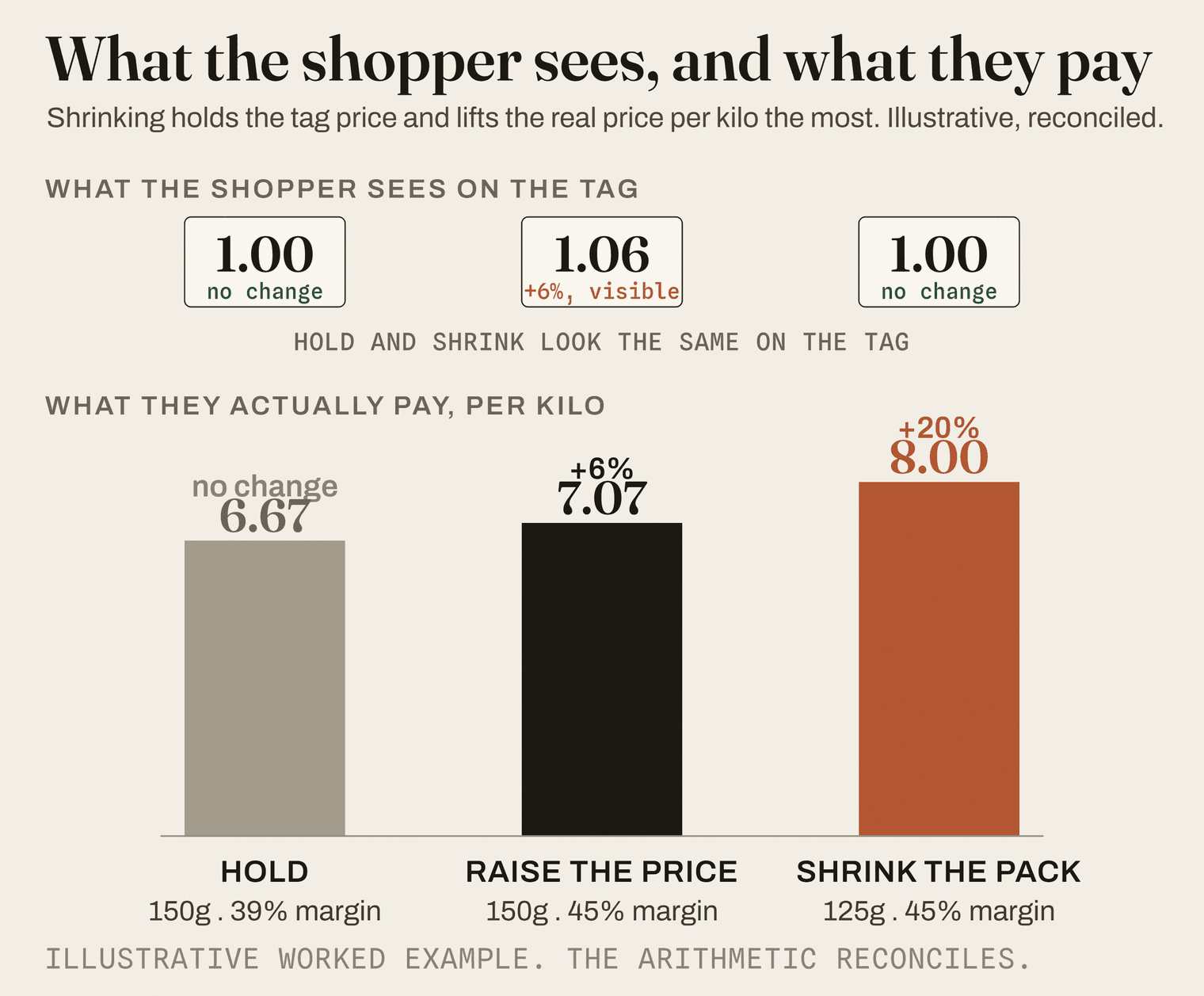
Take a snack that holds a 1.00 price point at 150 grams. The cost of the goods inside is 55 pence: 30 pence of ingredients, at 2.00 a kilo, plus 25 pence for everything else, the bag, the filling, the overhead that does not change much with size. That leaves 45 pence of gross profit on every pack, a 45 percent gross margin, and a price of 6.67 a kilo. Now a commodity spike lifts the ingredient cost by 20 percent, from 30 pence to 36 pence a pack. The 45 pence of profit is suddenly under pressure, and you reach for a door.
Gross margin, in one box. Gross margin is the share of each pound of sales left after you pay for the goods themselves. Sell a pack for 1.00 that cost you 55 pence to make and you keep 45 pence, a 45 percent gross margin. It is the number a cost shock attacks directly, and the number every door in this example is trying to protect. One quirk matters here: a bigger pack does not cost proportionally more to make, because the bag and the filling and the handling are much the same whatever goes inside. Run that backwards and a small cut in grams strips out ingredient cost while the fixed costs, and the price, stay put, which is why the margin comes back so fast. The example assumes you keep selling the same number of packs, which is the usual case for a shrink.
Door one, hold. You keep 150 grams at 1.00 and absorb the cost. Your gross profit falls from 45 pence to 39 pence a pack, a margin of 39 percent, down six points, and you keep all your shoppers. That is the cost of doing nothing, and it is a real number, six pence of profit gone on every single pack you sell.
Door two, raise the shelf price. To rebuild the 45 pence of profit you price at 1.06, the new 61 pence of cost (36 plus 25) plus your 45 pence. The shelf price is up 6 percent and so is the price per kilo, to 7.07. A 6 percent rise on the shelf costs you about 7 percent of your packs, because at the price sensitivity those same studies report, each 1 percent on the price loses you a little more than 1 percent of sales. A more price-sensitive line loses even more, which only widens the pack door's advantage. You have protected the profit on each pack you still sell, and paid for it in shoppers who walked.
Door three, shrink. You hold the 1.00 price point and cut the pack until the profit comes back to 45 pence. To do that the goods have to cost 55 pence again. That means the ingredients come back to 30 pence, and at the new price of 2.40 a kilo, 30 pence now buys only 125 grams. Your pack falls from 150 grams to 125, a cut of nearly 17 percent, and your price per kilo jumps to 8.00, up 20 percent. The shelf price has not moved a penny, so far fewer shoppers react, which is the half-the-loss advantage the studies describe. But look at the real price. The shrink raised your price per kilo by 20 percent, more than three times the 6 percent the shelf door showed, because you held a 1.00 ceiling against a much thinner pack.
That 20 percent is the number a unit-price label puts on the shelf edge, and the number an online filter sorts on. And a 17 percent cut is well past the 10 to 15 percent that goes unnoticed, so this version, a full margin recovery taken entirely through grams, is the worst of both worlds: a large hidden rise that is certain to be seen. You took the door that only pays while it is invisible, and then made a cut too big to stay invisible.
The disciplined move is smaller and louder. Take a trim at the gentle end of what usually passes unnoticed, say 10 percent, from 150 grams to 135. The profit climbs back to about 43 pence, a 43 percent margin, most of the way home from the 39 you would have by doing nothing, and the price per kilo rises 11 percent, to 7.41. Then say so. Put it on the pack, "now 135g," and recover the last sliver of margin somewhere the shopper does not pay for in trust, through your range or your trade terms. You have separated the two decisions that brands fatally merge: how much margin to recover, which is a question of economics, and how to disclose it, which is a question of trust. The size change should never be the part you hope no one notices. And treat any grams you take as gone for good, because when costs ease almost no one puts them back, so a shrink is a permanent change to your product, not a temporary patch. That alone is a reason to take less than the maths allows.
There is one more turn, and it is the one a pure pricing reflex misses. Whether a shrink even helps depends on your margin and how price-sensitive the line is. On a high-margin, easily-substituted premium product, shrinking can destroy more cash profit than it saves, because the small ingredient saving is swamped by the shoppers a noticed cut sends elsewhere. On that kind of line, as long as the margin is fat enough to fund the extra grams and those grams genuinely bring more sales, the move that grows cash profit is the opposite one: add product at the same price and let the extra sales pay for the thinner margin per pack [6]. "We must take price, so we shrink" is, for a meaningful slice of a premium range, financially backwards. Sometimes the right answer to a cost shock is to give the shopper more, not less, and to make sure they see it.
Who is closing the door that made shrinking quiet?
The pack door worked because the price per kilo sat in the small print where no one looked. That is exactly what is being taken away, by three forces at once.
The first is the law, and France wrote the template. Since July 2024 French shops above a certain size have had to put a label on the shelf flagging any product that shrank while its price held or rose, with fines up to 15,000 euros, and the duty sits on the retailer, not the maker [7]. The finance minister who brought it in called shrinkflation "a rip-off" and tied the rule to rebuilding consumer trust [7]. Hungary, Romania, and Italy followed with their own versions. There is no single European law yet, and the politics are genuinely unsettled: when Italy tried to force the disclosure onto every pack, the European Commission opened an infringement case, arguing that printing it on the product was disproportionate and that a label near the product on the shelf was the lighter way to do it [8]. Read that fight closely, because it tells you the durable design. The shelf-edge label, run by the retailer, survives. The on-pack label, forced on the manufacturer, gets challenged. Disclosure is coming, and it is coming at the shelf.
The second force is the unit price itself, made prominent. Where the shelf shows a clear, consistent price per kilo, the shopper who never did the maths does not have to, and the auditors in the United States found that inconsistent, badly formatted unit pricing is precisely what lets a shrink stay hidden [9]. Make the per-kilo number clear and you move shoppers from the mode where they anchor on the price point into the mode where they compare the real rate, and that second mode is the one in which shrinking reliably backfires.
The third force is the machine. Online and in AI shopping assistants, the default is to sort by price and by function, which surfaces the price per unit automatically and strips out the brand cues that used to carry a premium past it. The same technology that is growing the store brand is disarming the pack lever, because it computes the number the lever depends on you not computing.
Unit-price display, in one box. Unit-price display is the small line on the shelf label, and increasingly on the website, that shows the price per kilo, per litre, or per hundred sheets next to the pack price. It exists so a shopper can compare a 125-gram pack and a 150-gram pack like for like. It is also the exact device that converts a hidden shrink into a visible price rise, because it puts the number the shrink moved right next to the number the shrink held. As that line gets clearer and more consistent, by law or by retailer choice or by algorithm, the quiet door gets louder on its own.
Who wins the shelf when everyone shrinks, you or the retailer?
Brand teams tend to think of shrinkflation as a private decision between them and their cost sheet. It is not. The retailer holds the pen on the final shelf price and runs a competing product on the same shelf, and on this battlefield the retailer has the better hand.
Start with what the retailer can do to you. In 2023, a year before France made it law, the grocer Carrefour stuck its own labels on 26 products, telling shoppers each one had shrunk while the supplier's effective price rose, and named the makers. One example it flagged was an iced-tea bottle that shrank from 1.5 litres to 1.25 while its price rose, which the retailer marked as a 40 percent jump in the price per litre [10]. The retailer's communications director said the aim was to "stigmatise" the products and pressure the manufacturers to rethink their pricing [10]. A retailer can expose your shrink at the shelf, for free, whenever it strengthens their hand in a negotiation. So your pack decision is now also a trade-terms decision, because the most powerful actor in the channel can turn it into a weapon against you.
Now add what the retailer is selling beside you. The store brand now takes a record half of everything sold by unit across the big European grocery markets, more in some categories and less in others [11]. When your shrink lifts your price per kilo, it widens the gap to the own-brand sitting next to you, and it does it at the precise moment the unit-price label and the AI filter make that gap easy to see. The shopper who trades down does not usually come back. When prices go up, far more shoppers move to the store brand than move back when prices ease. So a noticed shrink is not a reversible price experiment, it is a one-way transfer of your shoppers to your retailer's own label, paid for with the one asset that let you charge more than them in the first place, the shopper's belief that you were worth it.
Regular readers will hear the echo of Issue 01. The squeezed middle of the range was being hollowed out by the discounters and the premium tiers at once, and the brands built for the broad middle were the most exposed. Shrinkflation is that same story told through the pack. A clumsy shrink takes a mainstream brand and nudges its price per kilo toward the premium tier on the maths while its perceived value stays stuck in the middle, which is the worst place on the shelf to be. The pack lever, used as a secret, accelerates the very trade-down it was meant to outrun.
There is even a trap in everyone doing it at once. If every brand in a category shrinks to hold the same price points, no one gains relative share, the category's real price drifts up together, and the shopper's sense of a fair price resets upward with it. But the retailer, who controls the shelf and owns a private label, can choose not to shrink its own product, instantly opening a visible value gap in its own favour and converting the whole industry's quiet cut into a private-label win. Before you assume a category-wide shrink is safe, war-game the one player who can profit from refusing to join in.
When does shrinking tip into skimping, and why is that the own goal?
There is a cousin of shrinkflation that is far more dangerous, and the discipline is never to let one become the other by accident. Shrinkflation makes the pack smaller. Skimpflation makes the product worse: a cheaper oil, less cocoa, a thinner recipe, the same size and price but a lower-quality thing inside.
The difference matters because of what the shopper can recover from. A shrink resizes a product the shopper still recognises and can choose again next week, so its cost is a one-off hit to fairness. A skimp degrades the experience itself, and the shopper tastes it or feels it, sometimes without knowing why, and simply stops enjoying the product. The casualty is the quality signal, the very thing that justified your price over the store brand, and quality lost is far harder to win back than a gram. A shrink is recoverable, but a broken product often is not.
Skimpflation is most dangerous exactly where your brand is supposed to be strongest, in the categories where people buy you for how good you are, the indulgences and the identity products, and in any category where the store brand has already closed the quality gap. It is least dangerous, relatively, in the plain commodity formats where there was never a quality claim to break. The rule for a commercial leader is blunt: a pack-price decision must never be allowed to cross into a recipe cut, because you can apologise for a smaller bag, and you cannot easily apologise your way back into someone's idea of a treat.
What does doing it in the open look like?
If the secret is the problem, the cure is to take the same cost recovery in the open, and pack-price architecture is how. Instead of trimming the routine pack toward a held price point and saying nothing, you build a visible ladder and let the shopper choose their rung.
This is the discipline that sits behind the jargon: matching a pack size and price to a specific occasion, shopper, and shop rather than selling one size to everyone. Used here it means you give every pack a job. Hold an entry price point with an openly smaller pack, the rung for the budget-conscious and the single-serve occasion, priced genuinely low. Keep or grow a clearly priced larger pack for the shopper who wants more per kilo. Recover your cost through the mix of what people choose, not through concealment, and the shopper self-selects into the smaller pack rather than discovering it after the fact.
The boundary that keeps you safe is the fairness rule shoppers actually apply. They grant you the right to cover a genuine cost increase, so a cost-justified move, disclosed, reads as fair. They do not grant you the right to expand margin behind their back, and a hidden shrink, once seen, reads as exactly that. Stay on the right side of that line by separating the economics from the communication every time, and by never making the size change the part you hope goes unread.
And keep the opposite move in your locker. The same psychology that makes a hidden shrink backfire makes an open upsize land disproportionately well. PepsiCo learned both halves in public. In 2023 its iced tea was among the products Carrefour shelf-shamed [10]; by late 2024, after a drop in both sales and snack volumes that its chief executive acknowledged on the earnings call, it reversed course and shipped bags with 20 percent more chips for the same price, flagged proudly on the front [12]. That is the pack lever run forward, as generosity, made loud on purpose. When your margins give you the room, a visible "more for the same price" is the cheapest trust you can buy, and it lands hardest precisely when your competitors are busy shrinking.
What would make me wrong?
The strongest case against my position is the awareness-action gap, and it is real. In Britain, concern about shrinkflation rose to 80 percent, and yet over the same two years the share of shoppers who said they would switch brands over it fell from half to a bit over a third [4]. People notice, and grumble, and mostly keep buying, because the whole category shrank together and there is often nowhere cheaper to defect to, and because the pack lever genuinely does lose only about half the sales a price rise would [1]. On that reading, the quiet shrink remains the rational tool, the trust cost is mostly talk, and a brand that tears up its range to avoid it is solving a problem the shopper has already forgiven.
I hold my position anyway, with the uncertainty on the table. The reason is that every force eroding the secret is getting stronger, not weaker: the disclosure laws are spreading, the unit price is getting more prominent, and the AI shopper that computes the price per kilo for you is arriving fast. The awareness-action gap is what you would expect in the last years of a tactic that worked, not evidence that it will keep working. What would actually prove me wrong is a full cost cycle in which noticing stays divorced from switching even as unit pricing becomes universal, and in which the store brand fails to capture the per-kilo gap that shrinking opens. I would put that at perhaps one chance in three for the plainest commodity staples, where the shopper never cared much about the brand, and considerably lower for anything bought on quality or identity, where being caught shrinking does lasting damage.
There is a second, more practical objection, and it is the fair one. The open ladder I am recommending is harder to build than a quiet trim. It needs the retailer to list new pack sizes and give them shelf space, it carries tooling and complexity cost, and a retailer can simply say no. A silent shrink needs none of that. So the open route can be the more expensive one to execute, and on a crowded shelf that cost is sometimes the deciding factor. My answer is that the quiet route is getting more expensive too, just on a slower clock and in a currency, trust, that does not show up until the shopper has already gone. If your portfolio is mostly the second kind, do not bet it on the gap holding.
What would I do on Monday?
Three moves, in order, and all three are really one move: rebuild the pricing capability the quiet lever let you neglect.
First, treat the price per kilo as your real shelf price, and model it. For every line, look at where a shrink would put your price per kilo, not just your pack price, because that is the number the label, the algorithm, and the store brand beside you will read. If a shrink pushes your per-kilo past the next round number, or past the store brand by a gap a shopper would notice, take the cost a different way.
Second, separate the cost-recovery decision from the disclosure decision, and write both down. Decide how much margin you need to recover on the economics. Decide how to tell the shopper on the trust. If you do shrink, keep the change small enough to be defensible, disclose it at the shelf with the reason, and bring the retailer in as a partner in the message rather than waiting for them to make it for you. Assume the change will be seen, because somewhere it is now the law and everywhere a rival or a journalist can make it so for free.
Third, build the open ladder before the store brand builds it for you. Put a genuinely smaller, openly priced entry pack on the shelf to hold the affordable rung, keep a clear value pack above it, and recover your cost through what shoppers choose rather than what they fail to notice. And when you have the headroom, use a visible upsize as a deliberate trust play, loudly, while your category is still trying to shrink in the dark.
Cost pressure is not going away, and the pack will always be one of the three doors you can take price through. What is going away is the dark the pack door used to operate in. The real decision this forces is not which trick to run next quarter, it is where to put your pricing energy over the next year, before the lever is fully gone. You can keep treating shrinkflation as a secret and lose the trust the moment the light comes on, which it now will, or you can take your cost recovery as architecture, in the open, and keep both the margin and the shopper. If it were my brand, I would stop shrinking in the dark and start building in the light, while the category is still deciding who shoppers can believe.
Signals
Five data points worth your time this week.
- France's shrinkflation labels have been law since July 2024: shops must flag any product that shrank while its price held, with fines up to 15,000 euros, and the duty sits on the retailer. https://www.euronews.com/business/2024/07/03/shrinkflation-stickers-come-into-force-in-french-supermarkets
- Across the European Union, 74 percent of shoppers say they have noticed packs shrinking, and 52 percent have noticed quality slipping, without a price drop (European Commission Consumer Conditions Scoreboard 2025). https://commission.europa.eu/document/download/2816337b-4fd1-4db2-a71c-d14a206a5a93_en?filename=consumer_conditions_scoreboard_2025_final.pdf
- British concern about shrinkflation rose to 80 percent in 2025, but the share who would switch brands over it fell from 50 percent to 36 percent, the awareness-action gap in one line (YouGov). https://yougov.com/en-gb/articles/52576-shrinkflation-concern-rises-in-2025-but-fewer-britons-are-changing-shopping-habits
- US auditors found product downsizing added just 0.06 of a percentage point to the 34.5 percent rise in consumer prices from 2019 to 2024 overall, but up to 3.0 points inside the hardest-hit categories like household paper (GAO). https://files.gao.gov/reports/GAO-25-107451/index.html
- After a drop in sales and snack volumes, PepsiCo reversed course and put 20 percent more chips in its bags for the same price, the pack lever run forward as generosity (Bakery and Snacks). https://www.bakeryandsnacks.com/Article/2024/10/17/PepsiCo-responds-to-shrinkflation-backlash/
References
- Janssen and Kasinger, "Shrinkflation and Consumer Demand," Marketing Science (the published extension of Gourville and Koehler, 2004, "Downsizing Price Increases"), finding pack-size demand roughly half as sensitive as price demand: https://pubsonline.informs.org/doi/10.1287/mksc.2024.0948
- Evangelidis, "Frontiers: Shrinkflation Aversion," Marketing Science, 2024, on consumers judging downsizing as more unfair than an equal price rise because it reads as deceptive: https://pubsonline.informs.org/doi/10.1287/mksc.2023.0269
- European Commission, Consumer Conditions Scoreboard 2025 (74 percent noticed size cuts, 52 percent quality cuts): https://commission.europa.eu/document/download/2816337b-4fd1-4db2-a71c-d14a206a5a93_en?filename=consumer_conditions_scoreboard_2025_final.pdf
- YouGov, "Shrinkflation concern rises in 2025 but fewer Britons are changing shopping habits" (80 percent concerned, switch intent down from 50 percent to 36 percent): https://yougov.com/en-gb/articles/52576-shrinkflation-concern-rises-in-2025-but-fewer-britons-are-changing-shopping-habits
- CivicScience, "Shrinkflation in 2025" (81 percent of US grocery shoppers have noticed it recently): https://civicscience.com/shrinkflation-in-2025-quality-is-key-for-loyal-customers/
- EY-Parthenon price-pack architecture, on the cash-margin-by-elasticity rule that on high-margin elastic lines an upsize at constant price beats a shrink: https://www.ey.com/content/dam/ey-unified-site/ey-com/en-uk/services/strategy-transactions/documents/ey-price-pack-architecture.pdf
- Euronews, "Shrinkflation stickers come into force in French supermarkets" (1 July 2024; retailer duty; fines to 15,000 euros; Bruno Le Maire "a rip-off"): https://www.euronews.com/business/2024/07/03/shrinkflation-stickers-come-into-force-in-french-supermarkets
- The European Sting, reproducing the European Commission March 2025 infringement package on Italy's on-pack shrinkflation labelling as disproportionate: https://europeansting.com/2025/03/13/march-infringements-package-key-decisions/
- US Government Accountability Office, report on shrinkflation and unit pricing (inconsistent unit-price formatting lets downsizing stay hidden; the 0.06 point and category figures): https://files.gao.gov/reports/GAO-25-107451/index.html
- CNN, "Carrefour adds shrinkflation labels to shame brands" (26 products stickered; iced tea 1.5L to 1.25L, a 40 percent rise per litre; the "stigmatise" quote): https://www.cnn.com/2023/09/15/business-food/carrefour-shrinkflation-stickers/index.html
- Circana, "Private label reaches a record 50 percent unit share across Europe's six biggest grocery markets" (2026): https://www.circana.com/post/private-label-reaches-record-50-unit-share-across-europe-s-six-biggest-grocery-markets
- Bakery and Snacks, "PepsiCo responds to shrinkflation backlash" (20 percent more chips for the same price after a sales and volume drop the CEO acknowledged): https://www.bakeryandsnacks.com/Article/2024/10/17/PepsiCo-responds-to-shrinkflation-backlash/