The Promotion Trap: Why Your Second-Biggest Cost Keeps Losing Money
Trade promotion is the second-largest line on your profit and loss, most individual deals do not pay back, and four forces make it hard to stop.
The short version
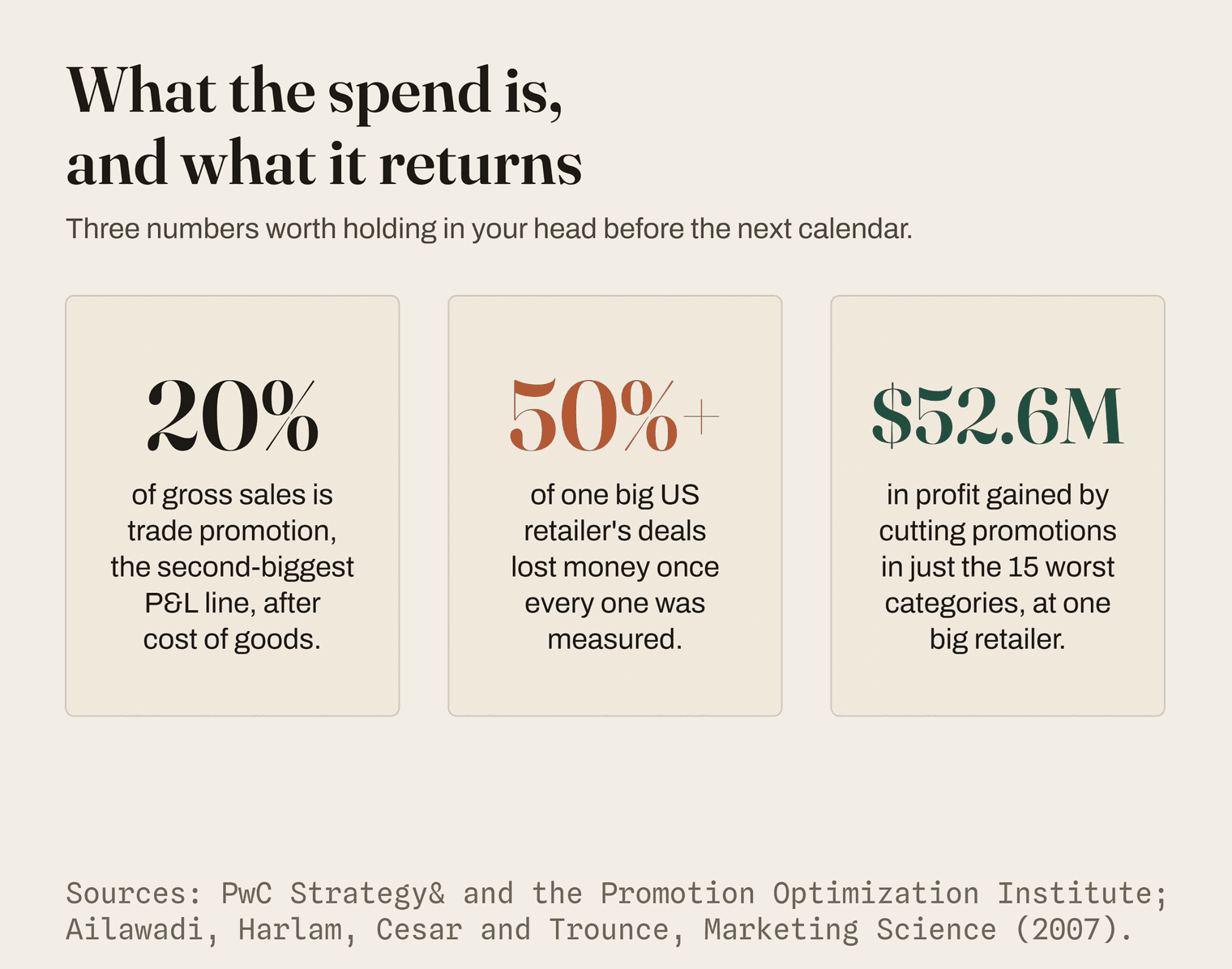
- Trade promotion is the second-largest line on a consumer goods maker's profit and loss after the cost of goods sold, around 20 percent of gross sales and roughly 200 billion dollars a year in the United States alone [1][2][3].
- The part nobody puts on a slide: when a large US retailer measured every promotion it ran in a year, more than half were unprofitable, and only about 45 percent of the volume they generated was genuinely incremental, the sales that happened only because of the deal [4]. The party that funds the deal, the brand, usually does worse than that.
- The reason it keeps happening is not stupidity. It is that the volume a deal creates is loud and visible, while the value it destroys is quiet and spread across four places nobody owns together: the source of the volume, the margin handed to the retailer, the reference price you train down, and a gross-to-net line that finance and sales each see only half of.
- My position: most individual promotions are not an investment, they are a transfer. You are paying to move volume you would have sold anyway, or borrowed from your own future. A minority genuinely recruit new buyers and are worth every cent. The job is not to stop promoting. It is to tell the two apart before the calendar locks you in.
- This is becoming urgent now. Post-inflation volumes are soft, so brands are leaning back on deals just as the deals work less well, and retail media has arrived with closed-loop measurement that is making promotion's old opacity indefensible.
- What to do Monday: get the true, source-of-volume return before you sign the calendar, cut the deals that subsidise loyal buyers, keep the few that recruit, change the headline metric from volume sold on deal to incremental profit, and put one owner on the whole gross-to-net and source-of-volume picture.
Your biggest hidden cost is a deal that doesn't pay back
Let me start with a number that should bother you more than it does. For most consumer packaged goods (CPG) companies, trade promotion, the money you pay retailers to cut prices, run features, and build displays, is the second-largest line on the entire profit and loss (P&L) statement. Bigger than advertising, bigger than your people, second only to the cost of goods sold. PwC's strategy arm puts US trade spending above 200 billion dollars a year, at about 20 percent of gross sales [1]. McKinsey has the same 20 percent globally [2]. The Promotion Optimization Institute, which surveys the industry every year, puts the range at 11 to 27 percent of revenue, and calls it "often the second largest expense on the P&L, after cost of goods sold" [3].
Sit with that. One in every five dollars of list-price revenue, give or take, goes back out the door as a deal. And here is the part that turns a big number into a worrying one. When Kusum Ailawadi and colleagues got inside CVS and measured the net profit impact of every single promotion the retailer ran across a year, they found that "more than 50% of promotions are not profitable because the lower promotional margin is not sufficiently offset by incremental units," that only "approximately 45% of the gross lift from promotions is incremental," and that cutting promotions in just the 15 worst-performing categories "will decrease sales by about $7.8 million but will improve profit by approximately $52.6 million" [4]. The retailer's promotions, taken as a whole, were profit-negative to the tune of 25.3 million dollars [4].
That is the retailer, the party that keeps the full retail margin. You, the brand, are in a worse spot, because you fund the deal and you absorb damage the retailer never sees. So when you hear the boardroom shorthand that "half of promotions don't work," the truth is harsher and better evidenced than the slogan. The question that should follow is the one almost nobody asks cleanly: if most of them lose money, why does the whole industry keep running them?
Why does a whole industry keep running deals that lose money?
Because four things hold the trap shut.
The first is the retailer. Promotions are written into the annual joint business plan (JBP), the negotiated agreement between a brand and a retailer that sets terms, volume, and support for the year. The deal calendar is the currency of that relationship. Pull a feature and you are not running a clean experiment, you are starting a fight with your largest customer, who can answer by handing your shelf space and your end-cap to the brand that did not blink.
The second is the calendar itself. A promotional plan is built a year ahead, slot by slot. Each slot has an owner, a volume target, and a history. "We always do the back-to-school feature" is not a strategy, it is a groove worn so deep that nobody remembers cutting the first one. Inertia is cheaper than confrontation, so the groove gets deeper.
The third is the scoreboard. The volume a promotion creates is gloriously visible. It shows up next week, in the same report everyone already reads, with a satisfying spike. The value it destroys is invisible: it is spread across future weeks as a dip, across other products as cannibalisation, and across the shopper's memory as a lower sense of what your product is worth. We manage what we can see, and a deal lets us see a mountain of volume while the cost drains away underneath it.
The fourth is the plumbing, and it is the one almost nobody understands, so it gets its own section below. The short version: the money for promotions flows through an accounting structure called gross-to-net that is designed to be hard to see, and it is split so that finance sees the cost while sales sees the volume, and the two halves rarely meet. When no single person can see the whole picture, the spend defends itself.
None of these four is irrational on its own. Together they are a machine for funding volume nobody has proven is worth funding. To break it, you have to see what the machine is actually buying.
What is a promotion actually selling?
When a deal sells an extra 18,000 units, those units are not all the same. Some are gold, most are fool's gold, and telling which is which, before you pay for it, is the entire skill.
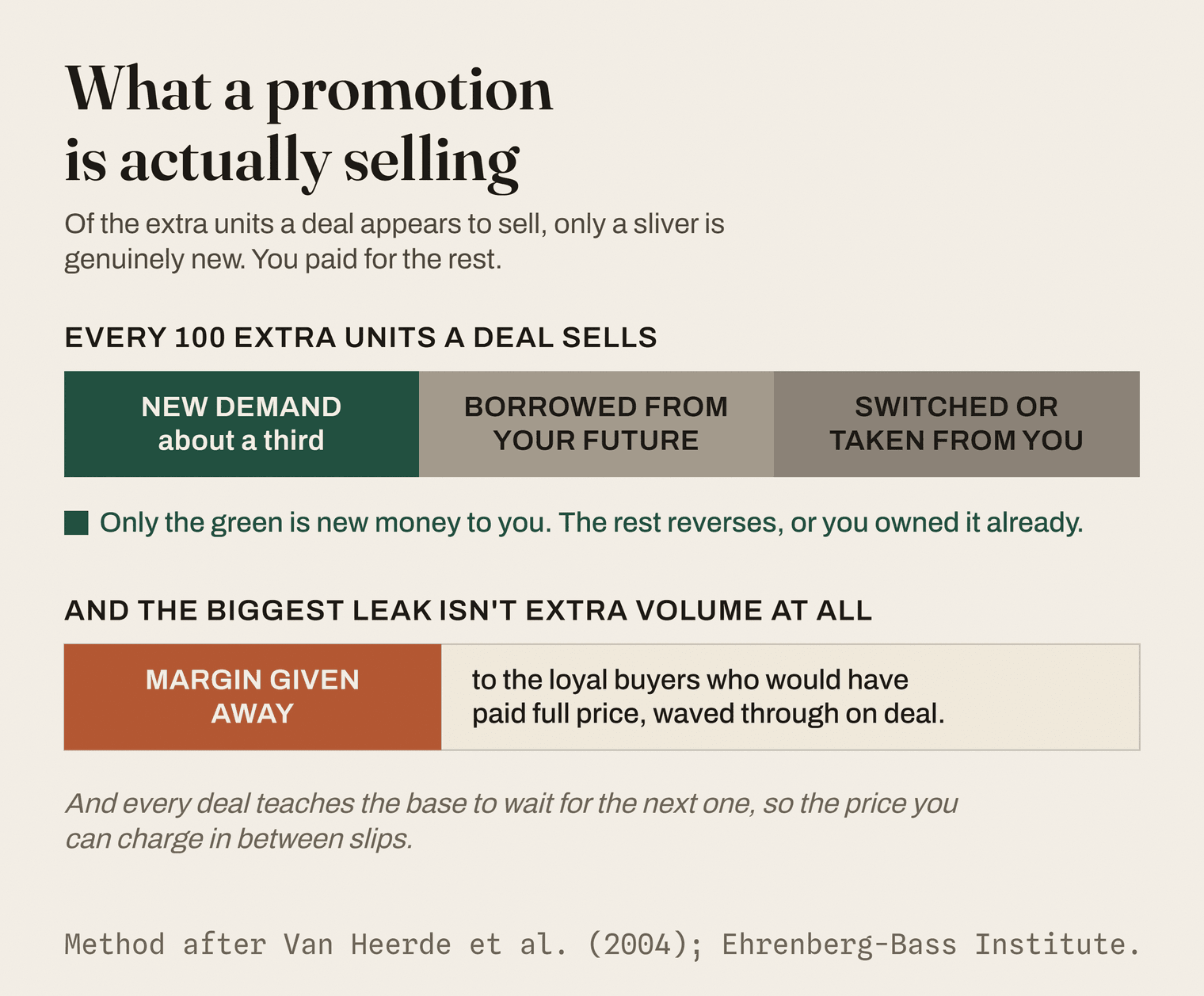
Concept box: source of volume. Your baseline is what you would have sold with no deal at all. When a promotion lifts sales above that baseline, the extra units come from very different places, and only some are worth anything. Think of every extra unit as one of three kinds. Real value: genuinely new or light buyers you tipped into a purchase, and true extra consumption that would not otherwise have happened. Volume you paid for: loyal buyers who would have paid full price anyway (a pure giveaway), units pulled forward from next month (borrowed, then repaid by a later dip), sales cannibalised from your own other packs, sales you simply moved from one store to another, and volume won from a rival who will just deal it back. And a hidden cost on the baseline itself: every deal teaches the shopper a little more to wait for the next one. Source of volume is the discipline of asking, for every uplift, how much was real and how much you simply paid for.
The academic spine here is sturdy. Harald van Heerde and colleagues decomposed the promotional bump using store scanner data and found that, measured in units, it splits into roughly three equal thirds: volume switched from other brands, volume borrowed from other time periods, and genuine category expansion [5]. Only that last third is new demand. The other two thirds are not new money to you: switched volume reverses the moment a rival deals back, and borrowed volume is repaid by a slump once the pantries you filled run down. Byron Sharp's work at the Ehrenberg-Bass Institute, set out in How Brands Grow, sharpens the point from the buyer side: the large majority of promotional volume goes to people who already buy you, only about 5 to 10 percent comes from new or rarely-buying households, and after the deal "sales promptly revert to baseline" [6]. And because shoppers stockpile when you discount, the raw scanner response wildly overstates true price sensitivity. Igal Hendel and Aviv Nevo showed that ignoring this stockpiling can "overestimate price sensitiveness by up to a factor of 2 to 6" [7].
Put those together and a deal that looks like a triumph on the volume report is mostly you, paying yourself, with your own future money. Which is easier to believe once you watch it happen to a single can of beans.
A deal that nearly triples volume and still loses money
Let me walk one all the way through. The numbers are illustrative, chosen so they reconcile to the cent, but every ratio sits inside the published evidence above.
Take an everyday ambient grocery staple, a can of beans. It sells for 2.00 dollars. It costs you 1.40 dollars to make and ship, so you earn 0.60 dollars a can, a 30 percent margin. In a normal week you sell 10,000 cans, which is 6,000 dollars of contribution.
Now you run the classic deal: 20 percent off for a week, with a feature in the retailer's flyer for which you pay a 1,500 dollar fee. The shelf price drops to 1.60 dollars, so your margin per can falls to 0.20 dollars. The deal works, on the scoreboard: you sell 28,000 cans. That is a plus 180 percent uplift, nearly triple your normal week. Your sales director is delighted.
Start with the break-even, because it is brutal and almost nobody runs it. To cover a 20 percent discount on a 30 percent margin, the volume you need is the discount divided by what is left of the margin after the discount: 0.20 / (0.30 minus 0.20), which is plus 200 percent. You needed to triple your volume just to stand still. You delivered plus 180 percent. You were under water before we even count the costs that do not show up this week.
Concept box: the break-even uplift. A discount cuts the margin on every unit you sell, including all the ones you would have sold anyway. So a deal has to clear a volume hurdle just to break even, and the hurdle is higher than people expect. The formula is simple: required uplift = discount / (margin minus discount). On a 30 percent margin, a 10 percent discount needs a 50 percent volume lift to break even, a 20 percent discount needs 200 percent, and a 25 percent discount needs 500 percent. Once the discount approaches your margin, no amount of extra volume can rescue it, because you are selling at cost. Run this one number before you approve any deal.
Now the in-week reckoning. Those 28,000 cans at 0.20 dollars each earn 5,600 dollars. Take off the 1,500 dollar feature fee and you are at 4,100 dollars, against a normal week of 6,000 dollars. So even on the simplest read, a week that nearly tripled your volume made 1,900 dollars less than doing nothing at all. The biggest reason is hiding in plain sight: 10,000 of those cans were loyal buyers who would have paid the full 2.00 dollars, and you waved them through at 1.60. That is 0.40 dollars each, 4,000 dollars of pure margin, given to people who never needed the deal.
It gets worse when you ask where the other 18,000 cans came from. Split them the way the research does: roughly 5,400 are genuinely new demand, about 4,500 are switchers won from rivals (real money this week, though it reverses when they deal back), around 6,300 were borrowed from your own future weeks, and about 1,800 were cannibalised from your other packs. The borrowed and cannibalised cans carry a tail. The 6,300 you pulled forward will not sell again next month, so you lose their full margin then, 6,300 times 0.60 dollars, or 3,780 dollars. The 1,800 you cannibalised cost your other packs their full margin too, 1,800 times 0.60 dollars, or 1,080 dollars. Add those two tails to the 1,900 dollar in-week loss and the true profit of this "successful" promotion is about minus 6,760 dollars. The 4,000 dollar giveaway is already inside that in-week figure, so it is not counted twice.
A deal that nearly tripled volume destroyed the better part of 7,000 dollars, and 4,000 dollars of it was simply handed to your most loyal customers. That is the promotion trap in one can of beans, and the largest piece of the damage never showed up on any promotion report, because it was a gift to people who would have bought you anyway.
Where the money really goes, and why no one sees it
Two places, and your accounting is built to hide both.
The first is the retailer. The discount and the fees are a transfer of margin from your P&L to theirs. In the beans example, the 4,000 dollars you handed loyal buyers and the 1,500 dollar fee are margin moved straight across the table, at no extra cost to the retailer. That is not automatically bad, you are buying something, but you should at least know you are buying it, and most of the time the deal moves more margin to the retailer than it makes for either of you.
The second is the structure called gross-to-net, and this is where the trap is engineered.
Concept box: gross-to-net. Gross-to-net is the staircase from your list price down to the money you actually book as revenue. Each step is a deduction: on-invoice discounts, volume rebates, promotional allowances, feature and display fees, coupon funding. Crucially, these are not costs that sit below your gross profit, they are subtracted from revenue at the very top, before you ever report a margin. Accountants call them contra-revenue, netted against sales rather than booked as a cost lower down. The classic Harvard Business Review work on the "pocket price waterfall" showed how, once every deduction is counted, the price a company actually pockets can fall to little more than half of list [9]. So a brand that thinks it runs a 45 percent gross margin can find it is really running 35 percent once the deductions are counted properly [8]. The money is real. It is just accounted for in a way that keeps it out of sight.
That accounting choice has a human consequence, and it is the heart of the organisational problem. Because trade spend is a deduction from revenue rather than a marketing budget, it tends to be owned by the sales team, who are measured on volume, while the cost of it lands in a gross-to-net line that finance reconciles months later through accruals. Finance sees a cost it cannot tie to specific deals. Sales sees volume it is proud of. Neither sees the combined picture of incremental profit in time to act on it. Simon-Kucher put the consequence plainly in late 2025: "Many organizations still reward sales teams based on volume or revenue, while RGM, finance, and leadership chase profitability. This misalignment drives short-termism, over-discounting, and value destruction" [10]. The opacity is not a data problem. It is a governance problem that data has finally made visible.
Are you training your shoppers to wait?
There is a third cost, and it is the most insidious, because it never appears in any week's numbers at all. It appears in every week's numbers, slightly, forever.
Every time you put your product on deal, you teach the shopper a little more about what it is "really" worth. Behavioural economists call the number in the shopper's head the internal reference price, and the research on how it forms is settled. Manoj Mazumdar and colleagues describe it as a weighted average of the prices a shopper has recently seen, with recent prices weighted most [13]. So if your product is on deal a quarter of the time, the deal price stops feeling like a treat and starts feeling like the price, and the full shelf price starts to feel like a rip-off.
That last word is not loose. In Tversky and Kahneman's later work on how people weigh gains and losses, a loss is felt about 2.25 times as intensely as the equivalent gain [11]. Once your deal has dragged the reference price down, paying full price is no longer a neutral act, it is a loss, and it stings more than twice as hard as the saving ever pleased. Kalyanaram and Winer, reviewing decades of scanner studies, confirmed the asymmetry: shoppers react more strongly when price is above their reference point than below it [12]. So the deal habit is not symmetric and it is not free. You can train a base down quickly and you can only rebuild it slowly.
Concept box: reference price. The reference price is the price a shopper unconsciously expects to pay, formed from the prices they have seen recently. Promotions pull it down: discount often enough and the sale price becomes the expected price, so full price feels like being overcharged. Because people feel losses about twice as hard as equivalent gains, that "overcharge" feeling does real damage to your base sales between deals. This is why heavy promotion is self-reinforcing: the more you discount, the more shoppers wait for the discount, the more you have to discount. The base erodes one deal at a time.
Here is the connection that should change how you read your own data. We are living through the aftermath of an inflation shock. CPG list prices sit roughly 30 percent above their 2019 levels, and shoppers still remember the old prices, so today's promoted price often fails to feel like a deal at all. Circana has tracked exactly this, with promotional lifts running well below their historical norms even as brands run more of them [14]. So you are caught in a vice: inflation lifted the sticker price your shopper resents, while years of discounting trained them to wait, and now the deals you are leaning on harder are working less well. Both jaws of that vice are reference-price effects. You are paying for both.
Why now? Retail media just moved the goalposts
If trade promotion has been unprofitable for decades without anyone stopping it, why write about it now? Because the thing that hid it is being dismantled from an unexpected direction.
Retail media, the advertising that retailers sell against their own shopper data, has exploded. US retail media ad spend reached about 58.8 billion dollars in 2025 [15], and Forrester, forecasting the global market past 300 billion dollars by 2030, explicitly names "brands reallocating trade marketing budgets" as one of the engines of that growth [16]. The usual story is that retail media is stealing trade dollars. That is true, but it is not the important part.
The important part is the measurement. Retail media is sold with closed-loop attribution: the retailer can show, shopper by shopper, what an ad actually caused. Once a brand is used to asking "what did this retail-media dollar truly drive," it cannot un-ask the question of the deal running three aisles over. The accountability standard that retail media imports is contagious, and it lands straight on the softest target in the building: the temporary price reduction (TPR) whose incrementality nobody has ever had to prove. Retail media's real threat to the promotion calendar is not that it takes the money. It is that it makes the old opacity impossible to defend.
Brand chiefs have said as much on recent earnings calls, leaning harder on deals as shoppers buy less [17]. Add the macro picture, soft volumes pushing brands toward more deals while margin pressure pushes finance to question every line, and you have the moment when the spend nobody could see becomes the spend nobody can avoid looking at.
What would make me wrong?
I have been hard on promotion, so let me make the strongest case against my own argument, because it is a real one and it changes what you should do.
Promotion is not always a transfer. Sometimes it genuinely recruits. Sharp's own data, for all that it deflates the average deal, shows that the largest absolute uplifts come from a brand's lightest buyers, the people who barely know you [6]. For a brand that is genuinely under-bought, that lacks what marketers call mental and physical availability, being easy to bring to mind and easy to find, a deal can buy trial that turns into a habit. A new product with no awareness, a brand entering a new market, a pack that needs a price bridge to get its first purchase: in those cases the 5 to 10 percent of volume that is truly new is the whole point, and cutting promotion would be a mistake.
There is also a number on the other side of the ledger that I should put on the table. The same CVS study that found most promotions unprofitable also found that a promoted product pulls a small basket of other purchases along with it, about 0.16 of a unit elsewhere in the store for every unit of lift [4]. For a retailer, that basket effect partly redeems the deal. For a brand, it mostly accrues to the retailer, which is one more reason your interests and your customer's are not as aligned as the JBP pretends. And promotion can be a defensive move: sometimes you run a deal you know will not pay back, purely to deny a rival the feature, the display, or the shelf. That is a real reason too, as long as you are choosing it with open eyes rather than by default.
And there is a warning for anyone who reads this and resolves to simply stop. Cutting promotion cold, after you have trained a base to expect it, is dangerous, precisely because of the loss aversion described above. When Procter and Gamble moved toward everyday low pricing in the 1990s, steady low shelf prices in place of high-low deals, and cut its deal and coupon frequency hard, including a coupon-frequency cut of around 54 percent, competitors escalated their own deals and advertising, and P&G lost about 18 percent of its share on average across the 24 categories studied before narrowing the strategy again [19]. JCPenney's abrupt removal of sales and coupons in 2012 is the retail cautionary tale, a fall of about 25 percent in comparable-store sales, some 4.3 billion dollars of revenue, in a single year [22], because it ripped out a reference price that customers had spent years internalising. And Kraft Heinz, having cut brand and trade investment to the bone under zero-based budgeting, where every cost must be rejustified from scratch, took a 15.4 billion dollar impairment charge, announced in early 2019, as those starved brands lost relevance [21]. You cannot crash-diet your way out of the promotion trap. The exit is surgical, not sudden.
So the falsifiable version of my position is this: if your brand is genuinely under-penetrated and your promotions are demonstrably recruiting new buyers who stay, then your deals are an investment and you should protect them. For most established brands running most of their calendar, that is not what the data shows, and the deals are a transfer. The point is to know which sentence describes each line of your plan.
What to do before you sign the next calendar
The decision this forces is not "promote or don't." It is "know what you are buying, and buy only the volume that is real." Five moves, in order.
First, get the true return before you commit, not after. For every recurring deal, demand a source-of-volume read against a proper baseline: how much of last year's uplift was genuinely incremental, and how much was subsidised base, borrowed volume, and cannibalisation. If nobody can answer, that itself is the finding, and the deal is guilty until proven innocent.
Second, cut the deals that subsidise loyal buyers. These are the ones with deep discounts, high baseline sales, and modest uplift: a lot of money moving a little new volume. As the CVS case suggests, a small slice of your worst activity may destroy more profit than your entire bottom quartile of products [4]. Find your version of those categories and stop.
Third, keep and feed the deals that recruit. Protect the activity that genuinely reaches light and new buyers, the trial-builders, the new-market price bridges. Promotion has a real job. Let it do that job and stop asking it to do the other one.
Fourth, change the headline number. As long as the scoreboard shows volume sold on deal, you will get more volume sold on deal. Put incremental profit, not promoted volume, at the top of the promotion review, and watch behaviour follow the metric. The planning-software vendor Anaplan frames it well: when teams "can see the likely P&L outcome in advance, they can stop repeating unprofitable activities," and it puts the prize from reallocating away from the losers at "as much as 1 to 2% of revenue... straight to the bottom line" [18].
Fifth, give the whole picture one owner. The deepest fix is structural. As long as sales owns the volume and finance owns the cost and neither owns the profit, the trap stays shut. Someone, call it revenue growth management (RGM), the discipline of managing price, pack, mix, and promotion together for profit, has to own the gross-to-net line and the source-of-volume truth at the same time. Simon-Kucher's prescription is sound: tie part of the commercial bonus to margin and promotional return, set discount guardrails, and co-own the customer plan across sales, finance, and RGM [10]. Until one person can see the volume and the cost in the same frame, you will keep paying to sell more and earn less.
The promotion trap is not that promotions are evil. It is that they are loud where they help you and silent where they hurt you, and the system is built to amplify the noise and muffle the cost. The brands that win the next few years will not be the ones that promote the most, or even the least. They will be the ones that can see clearly, before they sign, which of their deals are buying something and which are just buying volume they already owned.
Signals
- US retail media ad spend reached about 58.8 billion dollars in 2025 and is forecast to keep climbing, with trade-budget reallocation a named driver [15][16]. https://www.emarketer.com/content/retail-media-ad-spending-forecast-trends-h2-2025
- The Promotion Optimization Institute finds CPG companies spend 11 to 27 percent of revenue on trade promotion, the second-largest P&L line after the cost of goods [3]. https://poinstitute.com/tpm/
- A peer-reviewed study of one large US retailer found more than half its promotions unprofitable and only about 45 percent of promoted volume incremental [4]. https://ideas.repec.org/a/inm/ormksc/v26y2007i4p566-575.html
- Circana reports promotional lifts running below historical norms even as promotion rates rise, as post-inflation shoppers anchor to pre-pandemic prices [14]. https://consumerbrandsassociation.org/blog/circana-a-cautiously-optimistic-2024-outlook-for-consumer-packaged-goods-companies/
- Simon-Kucher warns that rewarding sales on volume while finance chases profit "drives short-termism, over-discounting, and value destruction" [10]. https://www.simon-kucher.com/en/insights/embedding-commercial-excellence-fmcg-breaking-down-barriers-and-building-success
References
- Strategy and (PwC). "Zero-based trade for CPG leaders." 2017. https://www.strategyand.pwc.com/gx/en/insights/2017/zbt-for-cpg-leaders.html
- McKinsey and Company. "How analytics can drive growth in consumer-packaged-goods trade promotions." 2019. https://www.mckinsey.com/capabilities/growth-marketing-and-sales/our-insights/how-analytics-can-drive-growth-in-consumer-packaged-goods-trade-promotions
- Promotion Optimization Institute. "Trade Promotion Management." https://poinstitute.com/tpm/
- Ailawadi, K.L., Harlam, B.A., Cesar, J., Trounce, D. "Quantifying and Improving Promotion Effectiveness at CVS." Marketing Science 26(4), 2007. https://ideas.repec.org/a/inm/ormksc/v26y2007i4p566-575.html
- Van Heerde, H.J., Leeflang, P.S.H., Wittink, D.R. "Decomposing the Sales Promotion Bump with Store Data." Marketing Science 23(3), 2004. https://research.rug.nl/en/publications/decomposing-the-sales-promotion-bump-with-store-data/
- Element Three, presenting Byron Sharp (Ehrenberg-Bass), "How Brands Grow." "What Price Promotions Really Do And What They Don't." 2025. https://elementthree.com/blog/what-price-promotions-really-do-and-what-they-dont/
- Hendel, I., Nevo, A. "Sales and Consumer Inventory." NBER Working Paper 9048 (Econometrica, 2006). https://www.nber.org/system/files/working_papers/w9048/w9048.pdf
- Eightx. "CPG Trade Spend and Deductions: Accounting Done Right." 2026. https://eightx.co/blog/cpg-trade-spend-accounting
- Marn, M.V., Rosiello, R.L. "Managing Price, Gaining Profit." Harvard Business Review, 1992. https://hbr.org/1992/09/managing-price-gaining-profit
- Simon-Kucher. "Embedding Commercial Excellence in FMCG." 2025. https://www.simon-kucher.com/en/insights/embedding-commercial-excellence-fmcg-breaking-down-barriers-and-building-success
- Tversky, A., Kahneman, D. "Advances in Prospect Theory: Cumulative Representation of Uncertainty." Journal of Risk and Uncertainty 5(4), 1992. https://doi.org/10.1007/BF00122574
- Kalyanaram, G., Winer, R.S. "Empirical Generalizations from Reference Price Research." Marketing Science 14(3), 1995. https://dl.acm.org/doi/abs/10.1287/mksc.14.3.g161
- Mazumdar, T., Raj, S.P., Sinha, I. "Reference Price Research: Review and Propositions." Journal of Marketing 69(4), 2005. https://journals.sagepub.com/doi/abs/10.1509/jmkg.2005.69.4.84
- Circana, via Consumer Brands Association. "A cautiously optimistic 2024 outlook for CPG." 2024. https://consumerbrandsassociation.org/blog/circana-a-cautiously-optimistic-2024-outlook-for-consumer-packaged-goods-companies/
- eMarketer. "Retail media ad spending forecast and trends, H2 2025." https://www.emarketer.com/content/retail-media-ad-spending-forecast-trends-h2-2025
- Forrester. "Global Retail Media Forecast 2030." https://www.forrester.com/blogs/global-retail-media-forecast-2030/
- Packaging Dive. "CPG executives lean on promotions amid inflation and soft volumes." 2024. https://www.packagingdive.com/news/cpg-promotions-inflation-consumer-spending-/716087/
- Anaplan. "Why CPG leaders are rethinking trade promotion management." https://www.anaplan.com/blog/why-cpg-leaders-are-rethinking-trade-promotion-management/
- Ailawadi, K.L., Lehmann, D.R., Neslin, S.A. "Market Response to a Major Policy Change in the Marketing Mix: Learning from P&G's Value Pricing Strategy." Journal of Marketing 65(1), 2001. https://business.columbia.edu/sites/default/files-efs/pubfiles/962/962.pdf
- Marketing Week. "P&G brand values slide." 1996. https://www.marketingweek.com/pg-brand-values-slide/
- Compliance Week. "Kraft Heinz discloses probe, takes $15.4B impairment charge." 2019. https://www.complianceweek.com/accounting-auditing/kraft-heinz-discloses-probe-takes-154b-impairment-charge/24787.article
- Retail Dive. "J.C. Penney nosedived in 2012, what's next?" Full-year comparable-store sales down about 25 percent; total sales down 4.3 billion dollars to 13 billion. https://www.retaildive.com/news/jcpenney-nosedived-in-2012-whats-next/104993/