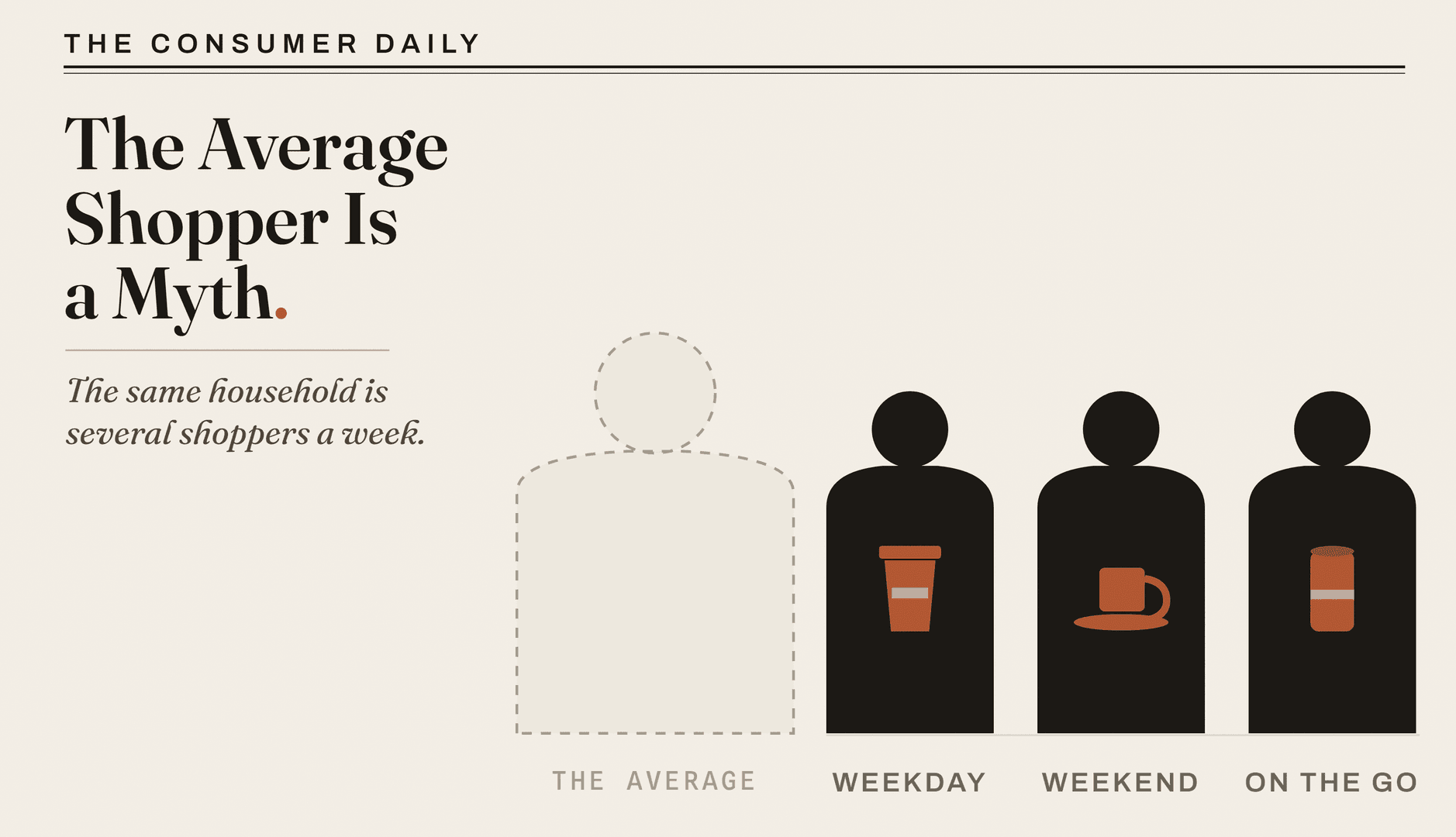
The Average Shopper Is a Myth: Segment the Occasion, Not the Person
The same household is several different shoppers across a week. The brands winning the shelf design their pack and price ladder around occasions.
The short version
- The average shopper is a statistical ghost. The average buyer of a category is no one in particular, and rival brands sell to almost identical kinds of people, so a plan built on who someone is barely predicts what ends up in their basket.
- The real structure of demand is the occasion, the mission and the need state. The same household behaves as several different shoppers across a week, and that is the cut that actually moves the basket.
- A segmentation insight is worth nothing until it reaches the shelf, and the thing that carries it there is your pack and price architecture. Occasion is literally the first letter of OBPPC (occasion, brand, pack, price, channel), so the shopper-insight work and the pack-price work are one job, and almost nobody runs them as one.
- My position: stop segmenting people and start segmenting demand. Re-cut the portfolio around occasions, rebuild the pack and price ladder around them, and put one team on the line that runs from the insight to the shelf.
- The growth purists have a serious objection, and I take it head on rather than dodge it: do not use occasions to narrow your audience. You segment to design the range, not to shrink your reach. Reach broadly, build for occasions, because an occasion is a door into the category, not a smaller room.
- This is suddenly operational. First-party data, retail media and AI have just made occasion-level targeting cheap and routine, so the gap between firms that re-cut around occasions and those still planning to a demographic average is about to widen fast.
- The worked example runs one household buying coffee for three occasions, reconciled to the last digit, and shows the margin a demographic plan leaves on the table that an occasion plan picks up on exactly the same shoppers.
Who is the average shopper, and what has she ever bought?
Somewhere in your building there is a slide with a face on it. She is called Sarah, she is 38, she has two children and a hybrid working week, she is health-conscious but time-poor, and she shops mindfully. Sarah is the average shopper, and Sarah has never bought anything in her life, because Sarah does not exist. She is the arithmetic mean of a few million real people wearing a stock photo, and the moment you follow any one of those real people through an actual week, the persona falls apart in your hands.
The same woman who buys the organic vegetables on Saturday buys the multipack of crisps for the kids' lunchboxes on Monday and grabs whatever is coldest and nearest at the petrol station on Thursday. She is, across one week, a premium shopper, a value shopper and a convenience shopper, and no single label predicts the next thing she puts in her basket. We know this is not a quirk of Sarah. It is a law. The Ehrenberg-Bass Institute has shown across category after category that rival brands sell to near-identical sets of customers. In credit cards, every brand large or small had roughly 19 percent of its customers aged 55 to 64 and about 46 percent women, whatever its market share [1]. Brands do not appeal to different kinds of people. They appeal to the same people in different numbers. Your carefully drawn target segment, more often than not, is just a smaller, blurrier picture of the whole market.
So the demographic profile, the thing a generation of brand plans was built on, turns out to be one of the weakest predictors of purchase we have. It tells you who someone is. It does not tell you what they came in for today. And what they came in for today is the only thing that decides what they buy.
If demand is not about who, what is it about?
If the person is the wrong unit, what is the right one? The answer the best operators have converged on is the occasion: the specific moment of need, defined by when and where and why and with whom, that sends someone into the category in the first place. Kantar, which has built a large part of its business on this idea, counts something like 82 billion individual food and drink occasions in Britain in a year, each with its own combination of who, when and why [2]. The unit of demand is the moment, not the shopper.
This is not soft theory. It shows up the instant you measure it. Read a household's loyalty-card baskets and the occasion they were shopping for jumps out of the receipt more sharply than anything you know about the household itself. Strip a basket back to the mission behind the trip and you can predict the next one better than the age, the postcode or the loyalty tier ever did. The practitioners say it more bluntly than the academics. One occasion-research firm puts it plainly: in the categories people buy often, "the occasion drives the needs and motivations behind each purchase more so than the person" [3]. The occasion is upstream of the person.
Sitting just underneath the occasion is the need state, the result the shopper actually wants from the product, the calm, the lift, the small reward. Euromonitor, which now sizes need states as commercial markets in their own right, describes a consumer who has become "category, occasion and substance agnostic," focused on the result they want rather than the product that delivers it [4]. When the job is "help me feel calm tonight," the competitive set is a herbal tea, a supplement, a gummy, a glass of wine and a meditation app all at once, and not one of them is in the same aisle. Map demand that way and the category lines you have organised your whole business around start to look like an accident of where the factory put things, not a description of what people want.
Occasions, missions and need states, in one box. Three words for layers of the same idea: demand defined by the moment, not the person. An occasion is the when, where, why and with whom of a consumption moment (the weekday breakfast, the Friday treat, the on-the-go pick-me-up). A mission is the shopping trip that serves it (the big stock-up, the top-up, the grab-and-go). A need state is the outcome wanted inside the moment (quick energy, a calm wind-down, a reward you have earned). All three describe what the shopper came for. None of them is who the shopper is, and that is exactly why they predict the basket when demographics cannot.
Why does a brilliant segmentation die on a slide?
Here is where most of this work goes to die, and where the real money is lost. A brand team commissions a beautiful occasion study. It comes back with seven vivid demand spaces, which is the trade's term for clusters of occasions, full of names like "Connected Indulgence" and "Functional Reset." Everyone nods. It wins an award. And then nothing happens, because a segmentation insight is worthless until it changes a pack, a price or a place on the shelf, and those decisions live in a different building from the insight.
This is the heart of the matter, so let me be precise about it. An occasion is not a marketing message. It is an instruction for your pack and price architecture. The framework the trade has used for this since Coca-Cola formalised it is OBPPC, and the letters are in causal order for a reason: Occasion comes first, and Brand, Pack, Price and Channel are meant to fall out of it. The occasion tells you the format (a single-serve can for on-the-go, a multipack for the household week), which tells you the price per serving, which tells you the channel where that pack belongs. The shopper-insight team that names the occasion and the revenue team that sets the pack ladder are, whether they know it or not, doing two halves of one job. The tragedy of the average is that almost no company runs them as one.
The consultants who study commercial models keep arriving at the same diagnosis. BCG, writing on volume-led growth in 2025, says revenue growth management has to be "the connective tissue between sales, which has a deep view of the retail partners, and marketing, which has deep insights into shoppers," and that the job is to turn deep consumer insight into "specific actions on pack-price architecture and promotions" [5]. Read that again with our argument in mind. The shopper insight and the pack-price architecture are named in the same breath as things that must be wired together, by someone, deliberately. When they are not, the brilliant segmentation stays on its slide, and the pack ladder gets set the way it was last year.
OBPPC, in one box. OBPPC stands for Occasion, Brand, Pack, Price, Channel, and the order is the strategy. You start from the consumption occasion, choose the brand that fits it, design the pack format that serves it, set the price per serving the occasion will bear, and place it in the channel where that occasion happens. Run the letters in that order and your range is built around demand. Run them backwards, starting from the pack the factory already makes and hunting for a moment to sell it into, and you get the portfolio most companies actually have: organised around what is easy to produce, not around what people came in to buy.
What is an occasion actually worth on the shelf?
A skeptic is entitled to ask whether any of this shows up in the profit and loss account, so let me put numbers on it. The prize from doing the pack-price half of this well is large and well documented. Roland Berger estimates that a transformational price pack architecture, the kind that deliberately builds for new occasions rather than just shrinking what exists, can lift EBIT (earnings before interest and tax) margin by up to 4 percentage points [6]. Bain, in its 2025 Consumer Products Report, puts the gain from a more granular, data-driven approach at 3 to 5 points of extra sales growth and 200 to 300 basis points of gross margin against competitors still working to the old averages [7]. These are not rounding errors. In a category where the average consumer-goods operator runs near a ten-year low on margin, a few points of either is the difference between leading a category and slipping out of it.
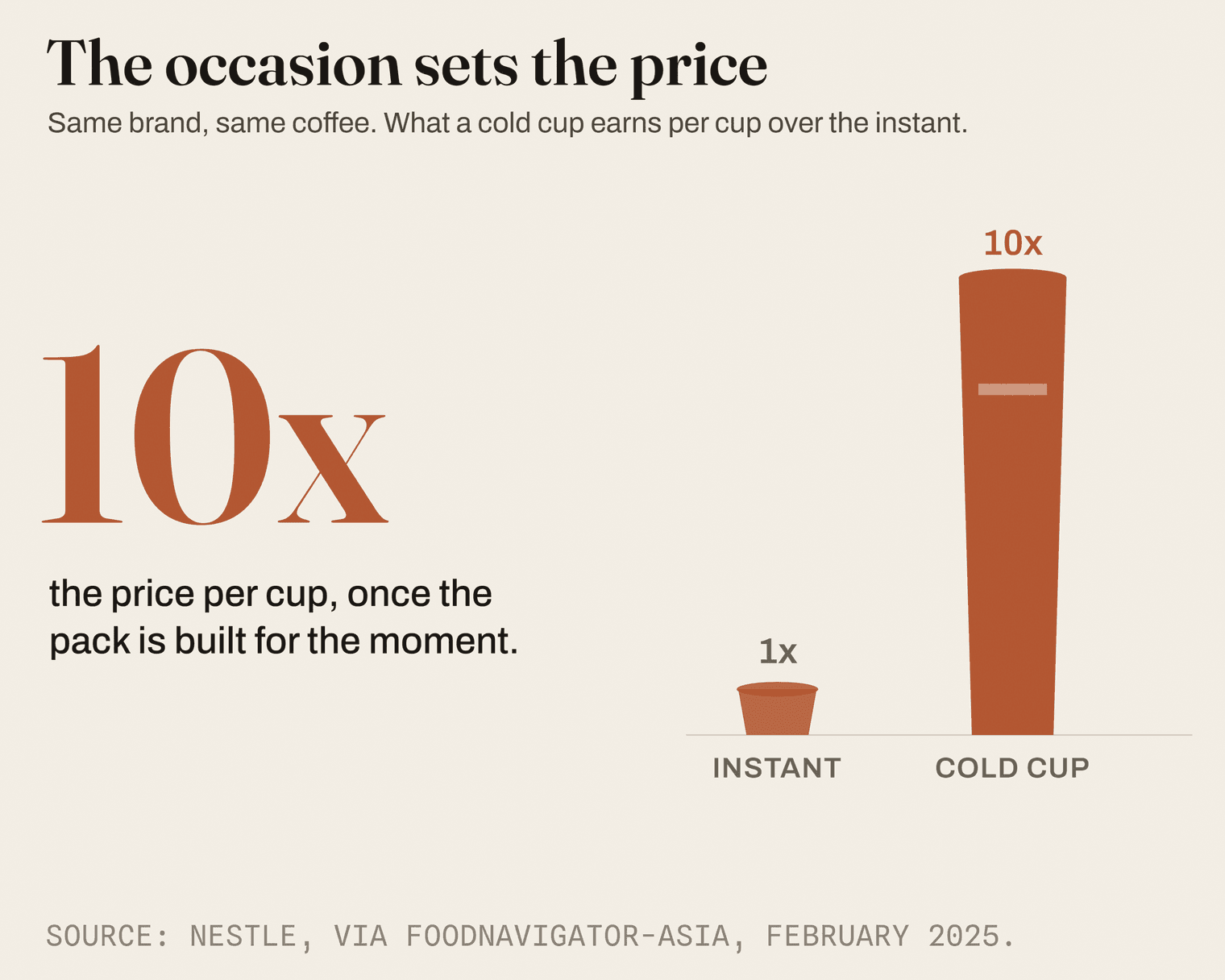
The cleanest live proof sits in coffee. Nestle runs three separate billion-dollar coffee brands, one for the everyday instant cup, one for the aspirational coffee-shop-at-home moment, one for the premium capsule ritual, each aimed at a distinct occasion at a distinct price. Then in 2024 it found a fast-growing occasion it was under-serving, the cold, iced, barista-style cup the young drink, and it built a new format for it, a concentrate, rather than hoping the existing range would stretch. The head of the coffee business described the new product as "a major youth recruiter as well as a major value generator as it is priced at 10x the price per cup compared to Nescafe Classic" [8]. Ten times the price per cup, from the same company, for the same caffeine, because the occasion was different and the pack was built for it. No demographic plan surfaces that. Only an occasion lens does.
This is the live work across the industry right now, not a theory. Mondelez, watching shoppers balk at pack prices above a psychological line, has rebuilt its US ladder around occasions and budgets at once, pulling big formats back below 4 dollars and adding new 3 dollar entry packs to win the price-sensitive moment [9]. Circana's analysts describe brands laddering deliberately by occasion: a ready-to-drink range sold as a variety eight-pack for trial, a single-flavour four-pack for the repeat buyer, and a single large can for the grab-and-go trip, three packs and three prices for three moments [10]. Even Diageo's new chief executive, Sir Dave Lewis, taking over a struggling spirits giant in early 2026, diagnosed the problem as a pack-architecture one, admitting the company was significantly underrepresented in the small-pack, lower-price occasion and committing publicly to sharpening its price pack architecture to fix it [11]. The vocabulary is everywhere now, but the discipline is still rare.
Price pack architecture, in one box. Price pack architecture (PPA) is the deliberate design of a brand's ladder of pack sizes and price points so that each rung serves a different occasion and budget. Done well, the entry pack recruits new and price-sensitive buyers, the core pack carries the everyday volume, and the premium pack captures the shoppers and moments that will pay more per unit. Done badly, you get overlap and confusion: a big pack that is not actually cheaper per gram than the small one, or two promotions that make two small packs cost less than the large. PPA is where an occasion insight becomes a thing on a shelf with a price on it. It is the second half of segmentation, and the half that pays.
What does it cost to plan to the average?
Let me make the cost of planning to the average concrete, with a worked example. The numbers here are invented to show the mechanism, but they reconcile, so you can redo the arithmetic yourself.
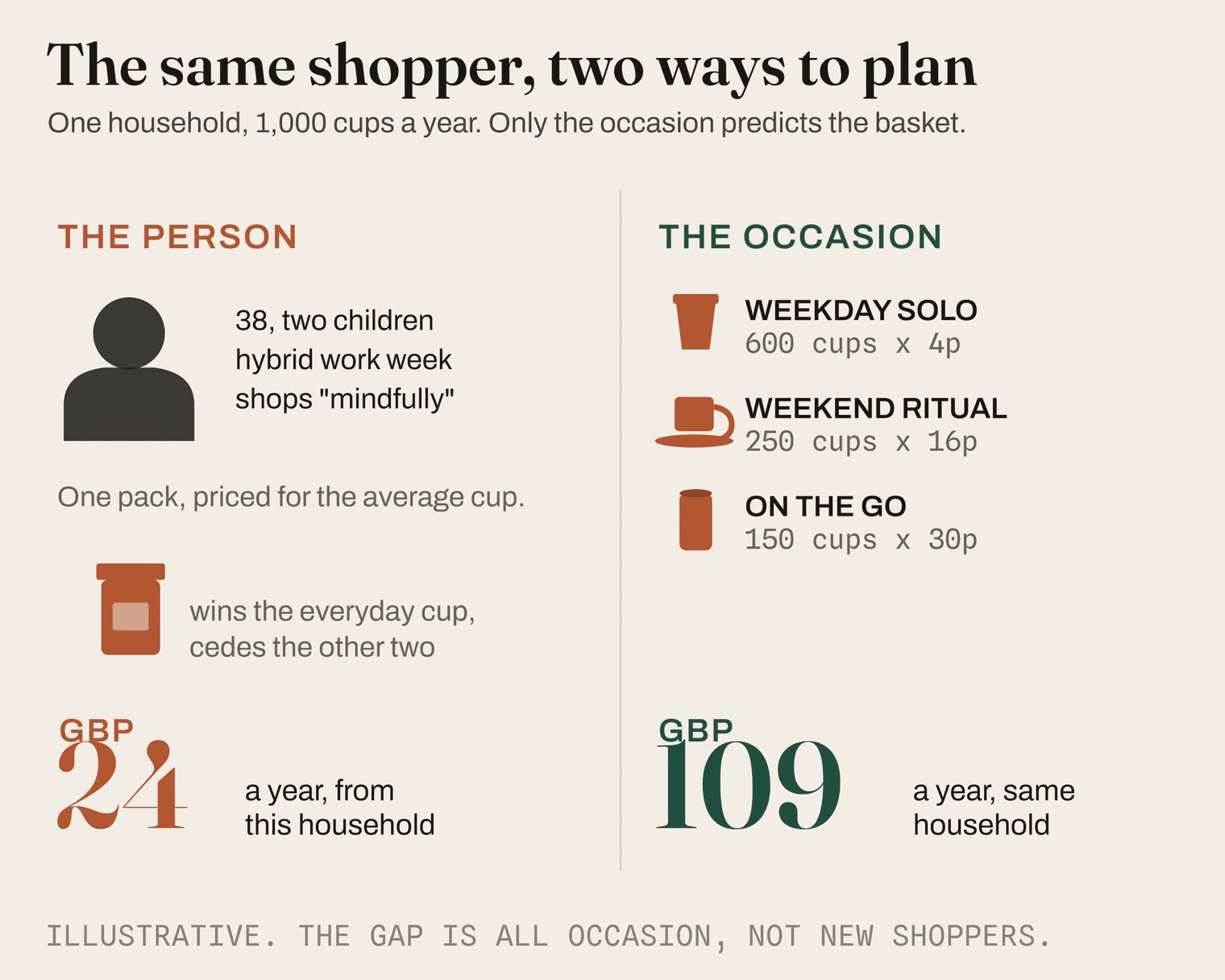
Take one household that drinks 1,000 cups of coffee a year. Those cups are not all the same cup. About 600 are the weekday-solo occasion: the fast, functional, get-me-going cup before work, where convenience beats everything and an instant is fine. About 250 are the weekend ritual: the slower, better cup made with care, where the household will happily trade up to a premium format. And about 150 are the on-the-go occasion: the cup bought away from home, where immediacy is the whole point and price sensitivity all but vanishes. Same household, same 1,000 cups, three completely different jobs.
A coffee company that plans to the average sees one customer and builds one product, a decent mid-tier instant, and prices it for the everyday cup. It wins the 600 weekday-solo cups at a manufacturer margin of about 4 pence each, and to keep the arithmetic clean, assume it wins only those, because its everyday product does not fit the other two occasions and cedes them to rivals who built for them. That is 600 times 4 pence, which is 24 pounds of margin a year from this household.
Now take the same household and a company that plans to the occasion. It still wins the 600 weekday-solo cups at 4 pence. But it also builds a premium format for the weekend ritual and earns about 16 pence on each of those 250 cups, and a ready-to-drink format for the on-the-go occasion and earns about 30 pence on each of those 150 cups. That is 600 times 4, plus 250 times 16, plus 150 times 30, which is 2,400 plus 4,000 plus 4,500 pence, or 109 pounds of margin a year. From the identical household, drinking the identical number of cups, the occasion plan earns 109 pounds against the demographic plan's 24 pounds, about four and a half times as much, a difference of 85 pounds a year, and not one extra shopper or one extra cup was required to get it. The clean all-or-nothing split is a simplification for the arithmetic. In reality the everyday product would scavenge a few of the premium cups, so the real gap is smaller, but the direction holds, because the margin on the occasions the average plan cedes runs four to seven times the everyday cup.
Scale that to five million such households and the 85 pound gap becomes 425 million pounds a year, none of it from winning new shoppers, all of it from serving the occasions the average was hiding. That is the cost of the average, and it is why the firm that re-cuts around occasions does not just edge ahead, it compounds a real and growing advantage.
But does not Ehrenberg-Bass say segmentation is a trap?
If you know your marketing science, you have been holding an objection for several paragraphs, and it is the strongest one against everything I have said, so let me put it on the table at full strength. The same Ehrenberg-Bass evidence that told us the average shopper is a myth also tells us, loudly, that brands grow by reaching more buyers, not fewer. Rival brands share near-identical customers, your niche is usually the whole market, light and occasional buyers drive most of your growth, and a loyalty-first strategy that narrows to a chosen few "is simply not a growth strategy" [12]. On the face of it, occasion segmentation looks like exactly the sin this work warns against: slicing the market into pieces and chasing one.
It is not, and the resolution is the sharpest point in this issue. You have to separate two completely different things that both get called segmentation. One is cutting up people and choosing which ones to talk to. That is the thing the evidence kills, and rightly. The other is cutting up demand and designing your range to fit it. That is the thing the same school actively recommends. Their own framework for growth, category entry points, is built on it: a category entry point is a buying situation, the cue of need, occasion, time or place that opens the category for a shopper, and the explicit instruction is to link your brand to as many of those situations as possible. As Jenni Romaniuk, who developed the idea, puts it, the game is "to be behind as many of those doors as possible" [13]. An occasion is a door. Building for more occasions opens more doors, which is the opposite of narrowing.
So the reconciliation is this, and it is worth saying slowly. You segment the demand, not the audience. You reach as broadly as you can, every category buyer is welcome, and you use the occasion map to design the packs, the prices, the formats and the innovations that let you show up correctly in more of those moments. Reach broadly, build for occasions. The coffee company in the worked example did not stop selling to anyone. It sold to the same household three times instead of once. That is penetration and pack architecture pulling in the same direction, which is what the growth evidence has wanted all along.
Category entry points, in one box. A category entry point (CEP) is the cue that makes a shopper think of a category in the first place: a need, an occasion, a time of day, a place, a mood. The Ehrenberg-Bass finding is that brands grow by becoming linked, in memory and on the shelf, to as many relevant CEPs as possible, because that is how you get noticed by the light and occasional buyers who drive growth. This is why occasion work and broad reach are allies, not enemies. The error the evidence warns against is "external" segmentation, narrowing which people you serve. The work it rewards is "internal" segmentation, designing your range around the buying situations. It is the same word for opposite moves. Build for more occasions to reach more buyers, not fewer.
Why is this suddenly real, after years of slideware?
Occasion segmentation is not a new idea, and a fair reader will ask why, if it is so powerful, it has sat on slides for two decades. The real answer is that until very recently it was expensive to act on. You could describe an occasion, but you could not cheaply find the shopper in that occasion, or change the offer for it in real time. That has just changed, and it is the reason this is a now problem and not an evergreen one.
The change has three parts, and they are arriving together. First, first-party retail data made occasions addressable: a retailer can now see that this basket, at this hour, is a top-up mission and not a stock-up, and target it. Kroger's data business showed an 11 percent incremental sales lift and a four to one return on ad spend for a brand targeting with first-party basket data rather than a bought demographic audience [14]. Second, the personalisation of the offer is moving from pilot to default. McKinsey's grocery work reports personalised promotions climbing from about 35 percent of grocers today toward 55 percent within two to three years [15], and a separate study documents one retailer booking 150 million dollars of value in a single year from gen-AI targeted offers on top of its pricing gains [16]. Third, the front door itself is changing: as shoppers start asking an AI assistant what to buy, the occasion, the stated need in the prompt, becomes the entire targeting surface, and the brand that has mapped its occasions cleanly is the one the machine can match. The unit that just became addressable, at scale and in real time, is not the individual and not the demographic. It is the occasion, and it is the one the shopper was in all along.
Why does almost nobody run it as one job?
If the prize is this clear and the tools are this ready, the obvious question is why so few companies capture it. The answer is not analytical. It is organisational, and it is the most fixable part of the whole story. The insight that names the occasion lives in consumer or shopper insight, usually inside marketing. The decision that sets the pack and the price lives in revenue growth management (RGM) or finance. They sit in different functions, on different calendars, measured on different numbers, and the wiring between them is thin or missing.
The people who study this say so without hedging. Simon-Kucher, writing on the RGM operating model, observes that "we rarely see a company excel across all RGM levers, combine them effectively, and embed this new way of working" across the organisation, and names misaligned incentives and siloed teams among the reasons [17]. EY, surveying 350 consumer-goods executives, found more than two-thirds admitting that siloed marketing, finance and commercial functions actively undermine brand performance [18]. The shopper insight team is measured on the quality of its research. The commercial team is measured on volume or revenue. Neither is measured on the joint outcome that this whole issue is about: the right pack, at the right price, in the right occasion. So the occasion study is filed, the pack ladder is set the way it always was, and the 85 pounds a household walks out of the door.
The fix is a design choice, not a technology purchase. It is a single owner, with a real profit and loss line, accountable for the journey from the occasion insight to the pack on the shelf, and a planning calendar that brings the insight work and the architecture work into the same room at the same time. Simon-Kucher puts the prize for getting the operating model right at 1 to 3 points of EBITDA (earnings before interest, tax, depreciation and amortisation) [19]. That is the same order of magnitude as the pack-architecture prize, which is the tell: the gap between knowing the occasion and acting on it is not a small operational seam. It is where most of the value leaks out.
So what do you do on Monday?
Three moves, and underneath them one idea: stop describing shoppers and start designing for occasions, end to end.
First, change what you measure. Retire the demographic target as your primary planning unit and replace it with an occasion map: the handful of consumption moments that explain most of your category's volume, sized in money, with your share of each. Then ask the only question that matters, which is not "who is my shopper" but "which occasions am I winning, which am I ceding, and what would it take to show up correctly in one more." Reach stays broad. The map tells you where to build, not who to drop.
Second, wire the insight to the shelf and give it one owner. The reason the brilliant segmentation dies is that nobody owns the line from the occasion study to the pack ladder. Appoint that owner, give them a profit and loss line that spans both, and put the shopper-insight people and the pack-price people on the same calendar so the occasion map actually sets the architecture instead of decorating it. This is the cheapest few points of margin in your business, because the analysis already exists and only the plumbing is missing.
Third, build for the occasions you are ceding, and resist the urge to narrow. Take the two or three occasions where your share is weakest and your map says the demand is real, and design the pack, the price and the channel to win them, the way the coffee company built a format for the cold cup it was missing. Do it to add reach, not to trade it away. The discipline is the one the growth evidence and the revenue evidence finally agree on: segment the demand, serve the many, and let the occasion, not the persona, decide what goes on the shelf.
What would make me wrong?
I hold this position, but a view is only worth the objections it survives, so here are the strongest cases against it.
The first is that I have understated the growth purists. A committed Ehrenberg-Bass reader could say that any energy spent on segmentation, even occasion segmentation, is energy not spent on the proven path of broad reach and mental availability, and that "occasion" is just a respectable new coat for the old sin of over-targeting. I take this seriously, and my defence is the distinction in the category entry points box: I am arguing for building the range around occasions while reaching everyone, which is their own prescription, not for narrowing the audience, which is the thing they refute. If a company uses an occasion map as an excuse to chase a premium niche and let its reach wither, the evidence says it will lose, and I would be the first to say it deserves to. The danger is real, and it lives in the execution, not the idea.
The second objection cuts at the method itself. Need states and occasions sized from the products already on shelf tend to flatter the occasions that incumbents already serve, because you are measuring demand through the lens of existing supply. Euromonitor, to its credit, says this out loud: you cannot fully size a need only from the products sold against it [4]. So an occasion map can be conservative, blind to the moment nobody serves yet, which is precisely the white space worth the most. The answer is to treat the map as a living instrument, refreshed with behavioural and qualitative data, not a one-off study, but I will concede that the method sees the present more clearly than the future.
Where does that leave my conviction? High, but not unconditional. For categories bought often, across genuinely distinct occasions, coffee, snacks, beverages, personal care, I would put the odds that occasion-led design beats demographic planning at better than four in five, and the only real risk is botching the execution by narrowing reach. For low-involvement commodities bought one way for one reason, the edge shrinks toward nothing, and a plain reach-and-availability strategy may be all you need. The average shopper is still a myth in those categories too. It just costs you less to believe in her.
Signals
Five things worth your attention this week, each a piece of the same story.
- The myth, measured. Ehrenberg-Bass shows rival brands sell to near-identical customers, roughly the same age and gender split whatever their market share, which means your demographic target is mostly the whole market in disguise. https://www.marketingweek.com/law-brand-user-profiles-sharpest-nail-hyper-targeting/
- The prize, quantified. Roland Berger estimates a transformational price pack architecture, one that builds for new occasions rather than shrinking what exists, can add up to 4 percentage points of EBIT margin. https://www.rolandberger.com/en/Insights/Publications/More-brilliant-pack-design-How-Price-Pack-Architecture-is-powering-FMCG-growth.html
- The occasion premium, made concrete. A cold-coffee occasion commands about 10 times the price per cup of the same company's instant, once a pack is built for it, the clearest proof that the moment, not the demographic, sets the price. https://www.foodnavigator-asia.com/Article/2025/02/04/coffee-shop-at-home-nestle-unveils-strategies-to-bring-coffee-business-to-next-level/
- The shift is going operational. McKinsey's grocery research has personalised promotions climbing from about 35 percent of grocers today toward 55 percent within two to three years, which is occasion targeting becoming the default. https://www.mckinsey.com/industries/retail/our-insights/the-state-of-grocery-north-america
- The barrier is the org chart. More than two-thirds of consumer-goods executives told EY that siloed marketing, finance and commercial functions undermine brand performance, which is why the occasion insight so rarely reaches the shelf. https://www.ey.com/en_gl/insights/consumer-products/three-ways-cpg-can-create-an-operating-model-that-reignites-growth
References
- Tom Roach on Ehrenberg-Bass research by Byron Sharp and Nicole Hartnett, "The law of brand user profiles," Marketing Week, March 2023. https://www.marketingweek.com/law-brand-user-profiles-sharpest-nail-hyper-targeting/
- Kantar, "The who, why and when behind category and brand growth" (demand spaces and consumption occasions). https://www.kantar.com/inspiration/fmcg/the-who-why-and-when-behind-category-and-brand-growth
- Catapult Insights, "The case for occasion-based segmentation," 2024. https://catapultinsights.com/the-case-for-occasion-based-segmentation/
- Shane MacGuill, "Mapping and Measuring Consumer Need States for Market Insights," Euromonitor International, January 2025. https://www.euromonitor.com/article/mapping-and-measuring-consumer-need-states
- Boston Consulting Group, "Driving Successful Volume-Led Growth in Consumer Markets," 2025. https://www.bcg.com/publications/2025/driving-volume-led-growth-in-consumer-markets
- Roland Berger, "More brilliant pack design: how Price Pack Architecture is powering FMCG growth," April 2025. https://www.rolandberger.com/en/Insights/Publications/More-brilliant-pack-design-How-Price-Pack-Architecture-is-powering-FMCG-growth.html
- Bain and Company, "Consumer Products Report 2025: Reclaiming Relevance in the Gen AI Era." https://www.bain.com/insights/consumer-products-report-2025-reclaiming-relevance-in-the-gen-ai-era/
- David Rennie, Head of Nestle Coffee Brands, on the cold-coffee concentrate priced at 10x per cup, via FoodNavigator-Asia, February 2025. https://www.foodnavigator-asia.com/Article/2025/02/04/coffee-shop-at-home-nestle-unveils-strategies-to-bring-coffee-business-to-next-level/
- Luca Zaramella, Mondelez CFO, on 3 dollar entry packs and the sub-4 dollar ladder, via Food Business News, June 2024. https://www.foodbusinessnews.net/articles/26290-mondelez-plans-3-offerings-for-us-in-second-half
- Circana, on pack-size laddering by occasion (Surfside, Kleenex, Graza), via Packaging Dive, 2025. https://www.packagingdive.com/news/cpg-food-beverage-trends-pack-sizes-circana/817399/
- Dave Lewis, Diageo CEO, on sharpening price pack architecture in small-pack occasions, via The Spirits Business, February 2026. https://www.thespiritsbusiness.com/2026/02/diageo-ceo-sets-sights-on-mass-market/
- Jenni Romaniuk and Byron Sharp, How Brands Grow Part 2, Oxford University Press, 2016 (penetration over loyalty, reach all category buyers); quotations confirmed against published reader's notes with page references. https://www.willpatrick.co.uk/notes/how-brands-grow-part-2-romaniuk-sharp/
- Jenni Romaniuk on category entry points as buying situations (the brand wants to be "behind as many of those doors as possible"), Ehrenberg-Bass Institute, via Marketing Week, 2022. https://www.marketingweek.com/ehrenberg-bass-category-entry-points/
- 84.51 and Kroger Precision Marketing case study, via Advertising Week, 2025. https://advertisingweek.com/case-study-kroger-precision-marketing-proving-the-power-of-retail-media-at-scale/
- McKinsey and Company, "The State of Grocery, North America 2026." https://www.mckinsey.com/industries/retail/our-insights/the-state-of-grocery-north-america
- McKinsey and Company, "Unlocking the next frontier of personalized marketing," January 2025. https://www.mckinsey.com/capabilities/growth-marketing-and-sales/our-insights/unlocking-the-next-frontier-of-personalized-marketing
- Simon-Kucher, "Time to transform your RGM organization," 2024. https://www.simon-kucher.com/en/insights/time-transform-your-rgm-organization
- EY, "Three ways CPG can create an operating model that reignites growth," 2025. https://www.ey.com/en_gl/insights/consumer-products/three-ways-cpg-can-create-an-operating-model-that-reignites-growth
- Simon-Kucher, "Succeed with the end-to-end integration of RGM systems" (1 to 3 points of EBITDA from the operating-model fix), 2025. https://www.simon-kucher.com/en/insights/succeed-e2e-integration-rgm-systems