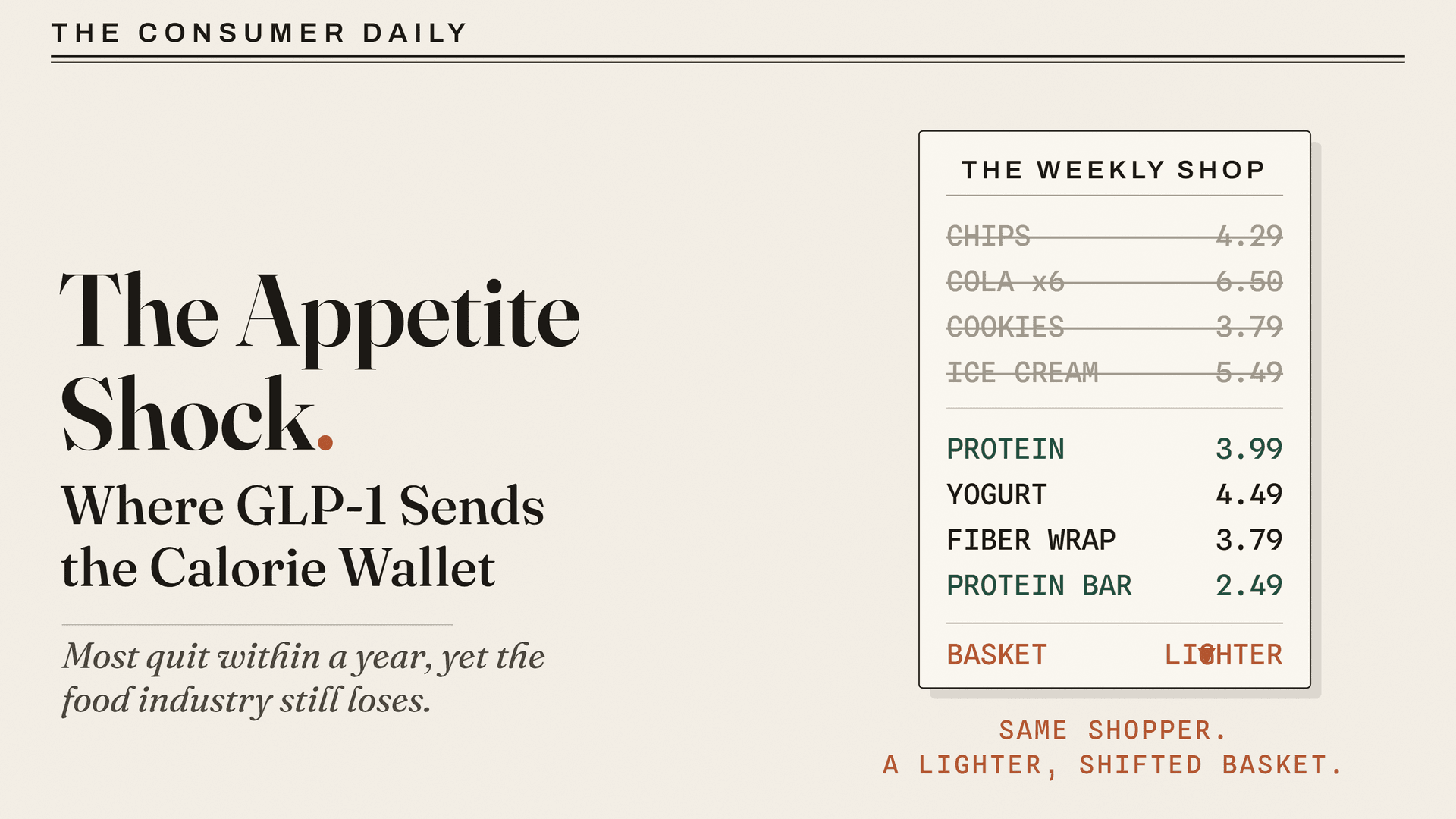
The Appetite Shock: Where GLP-1 Sends the Calorie Wallet
Most people on the drugs stop within a year, and the food industry still loses, because the spending is draining out of the centre of the store.
The short version
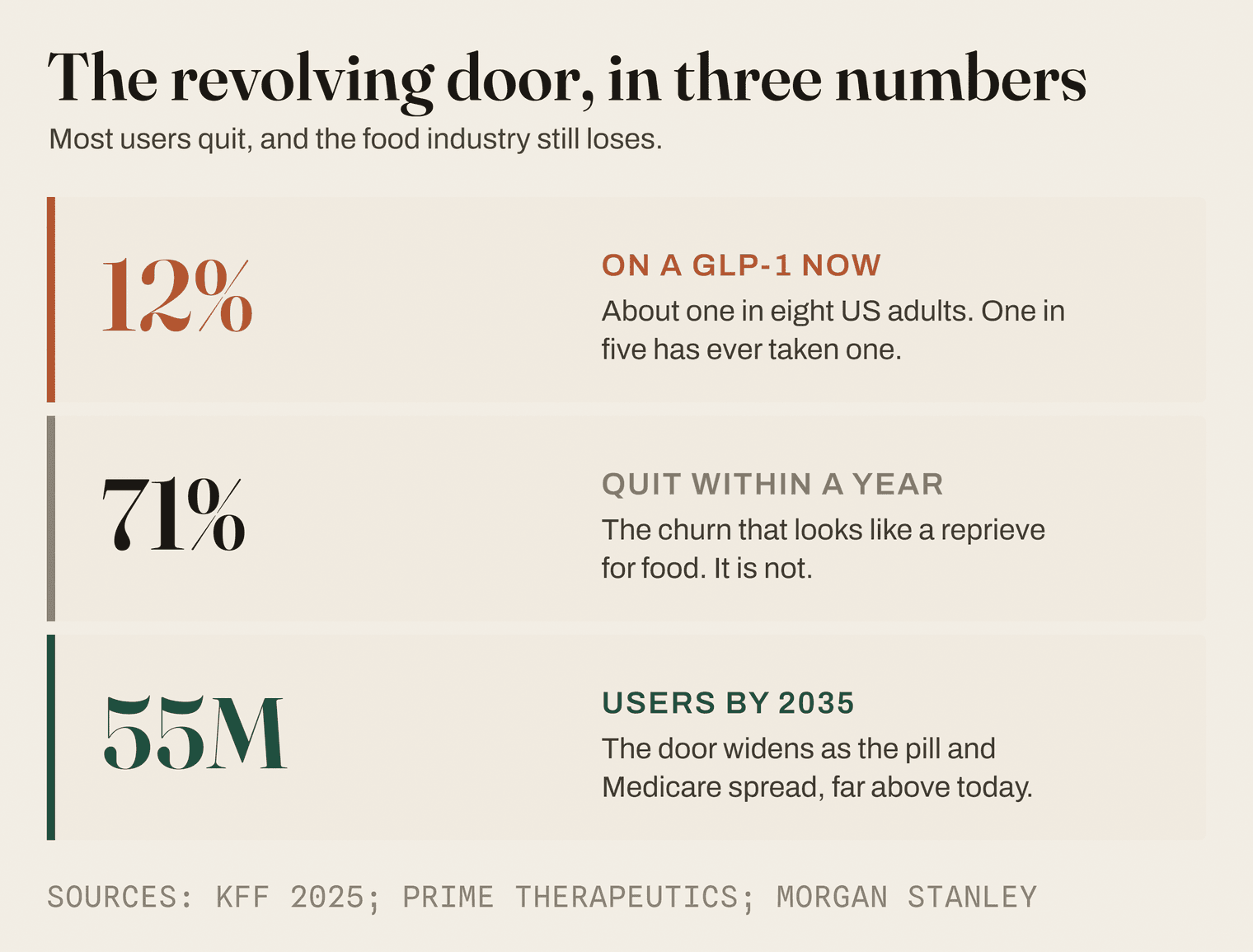
- About one in eight American adults is on a GLP-1 weight-loss drug right now, and one in five has tried one [1]. The drugs cut how much their users eat, and the grocery basket is already showing it.
- The comforting counter-argument is that most users quit. They do: seven in ten stop within a year [2]. I argue that this does not save the food industry, because the oral pill and Medicare coverage are widening the door faster than people leave through it [3][4].
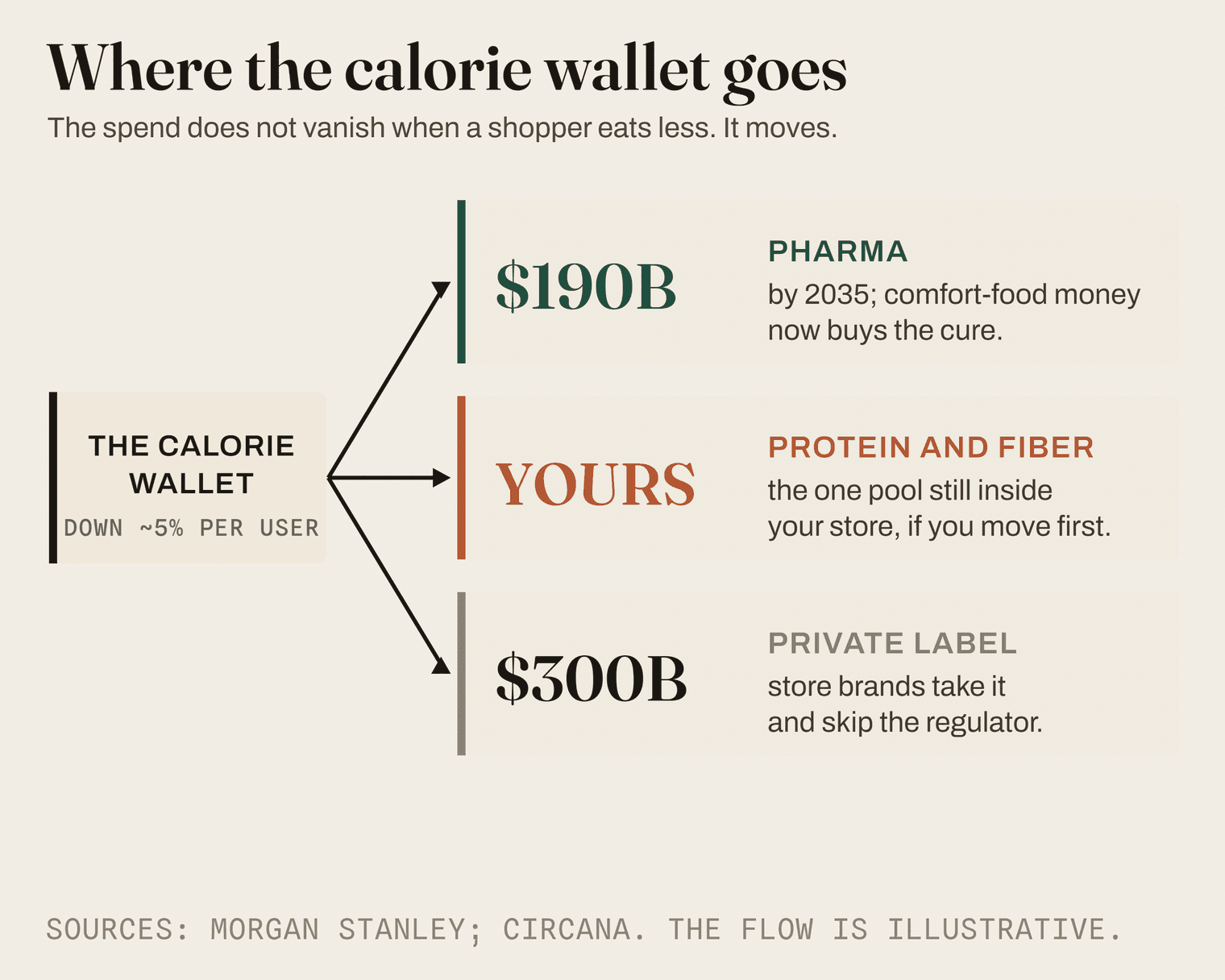
- The money does not vanish when a shopper eats less. It migrates. I trace it leaving the center of the store and landing in three places: pharma, protein and fiber, and private label.
- The shopper has changed how they choose, not just how much they buy. They are no longer counting calories down, they are counting protein per bite up. Brands that reformulate toward "low calorie" are aiming at the instinct the drug already switched off.
- My position: stop defending center-store volume with deeper promotions, which is the one move that reliably destroys profit here, and rebuild the pack range around small, protein-dense formats that the GLP-1 shopper will pay a premium for.
- In this issue's worked example, the re-architected portfolio earns about 23 percent more gross profit than doing nothing while the category shrinks, and defending the line with promotion is the only branch that loses money outright.
- The quiet land grab is on the digital shelf, where most retailer sites still tag food for Keto and Paleo while far more shoppers are on GLP-1, so the brand that defines the "GLP-1 friendly" aisle first will shape the search results, and the AI answers too.
Why is the food industry losing even though most GLP-1 users quit?
Start with the fact that is supposed to be reassuring. If you sell food, the GLP-1 story you want to believe goes like this: the drugs are expensive, the side effects are unpleasant, people cannot stay on them, so the whole thing is a spike that will pass. The first part is true. Roughly seven in ten people who start a GLP-1 for weight loss have stopped within twelve months, and only about one in twelve is still taking it after three years [2]. As a persistence curve, that is brutal. If this were a subscription business, you would call it a churn emergency.
So why am I not relaxed if I run a snack brand? Because churn is not the same as decline when the top of the funnel keeps getting wider. About 12 percent of US adults say they are on a GLP-1 today, and 18 percent have taken one at some point [1]. The gap between those two numbers is the churn you can already see in the population. The reason the 12 percent holds up despite that churn is that new people keep starting, and two things just made starting much easier.
The first is the pill. On 1 April 2026 the Food and Drug Administration approved Eli Lilly's orforglipron, sold as Foundayo, the first oral GLP-1 for weight loss you can take any time of day with no food or water restrictions, at a list price of 149 dollars a month for self-pay, as little as 25 with commercial insurance, and 50 for Medicare patients from July [3]. Compare that to 800 to 1,000 dollars a month for the injectables without insurance, before you even count the needle, and you can see the barrier falling. Morgan Stanley read the same shift and raised its forecast for US GLP-1 users to about 55 million by 2035, up from a previous 33 million, naming the oral format and Medicare coverage as the two reasons for the upgrade [4].
GLP-1, in one box. GLP-1 drugs (semaglutide, sold as Ozempic and Wegovy; tirzepatide, sold as Mounjaro and Zepbound; and now oral orforglipron) copy a gut hormone that tells your brain you are full. They slow how fast the stomach empties and dial down appetite, so users eat less without trying. Trial users lose around 15 to 20 percent of body weight, and surveys put the cut in daily calories at 20 to 30 percent. For a food company, the mechanism that matters is simple: the same person walks the same aisle and wants less of it.
Put the two together and you get a revolving door, not a cliff and not a passing spike. People leave fast, but more people keep arriving, and the arrivals are growing because the drug just got cheaper and easier to take. The steady-state number of people eating less is governed by how many stay on the drug, which is a smaller figure than the headlines about "ever tried" suggest, and you should size your exposure to the persistent users rather than the cumulative ones. But that steady state is rising, not fading. The right way to hold this is with both hands: the per-person shock is temporary, and the aggregate shock is still growing. A brand that plans for the spike to pass will keep being surprised that the basket never fully comes back.
Where does the calorie wallet actually go?
When a GLP-1 user eats less, the money they used to spend on those calories does not leave the economy. It moves. I find it useful to picture a calorie wallet: a fixed-ish amount a household routes through food, drink, and the things adjacent to them. GLP-1 does not empty the wallet. It redirects it.
The first evidence is in the grocery data. A study published this year in the Journal of Marketing Research, built on a 22,691-household panel, found that grocery spending falls 5.3 percent within six months of a household starting GLP-1, and 8.2 percent in higher-income households, with savory snacks down 10.1 percent and spending at fast-food and coffee shops down 8 percent [5]. That is the wallet starting to drain from the center of the store. Now follow where it goes.
Profit pool, in plain words. A profit pool is the total profit available at a point in a value chain, and the share each player captures. The useful trick is that demand can move from one pool to another without disappearing. When a shopper stops buying a chocolate bar because a drug killed the craving, the craving's money does not evaporate. It shows up as a prescription, a protein shake, or a store-brand high-fiber wrap. Same wallet, different pool. The strategic question is never just "how much volume did I lose," it is "which pool did my volume become, and can I reach it."
Pool one is pharma, and it is enormous. Lilly reported first-quarter 2026 revenue of 19.8 billion dollars, up 56 percent on the year, and raised its full-year guidance to 82 to 85 billion, while Novo Nordisk guided to a decline as it loses share [8]. Morgan Stanley expects the global market for obesity and diabetes treatments to reach 190 billion dollars by 2035 [7]. Some of the money that used to buy comfort food now buys the drug that removes the wish for it. Pharma in the strict sense is a pool you cannot enter without a drug pipeline, though ingredient supply and functional or medical nutrition are adjacent pools a few large food companies can reach with a different business model. For most brands it is closed, so I will spend the rest of this on the two pools you can reach.
Pool two is protein and fiber, the macronutrients a GLP-1 user actively seeks to hold onto muscle and feel full on less. This is the one destination still inside your own store, the pool you can still capture, and the demand signal is loud: Circana projects that GLP-1 households, already 23 percent of US households, will account for 35 percent of all US food and beverage units sold by 2030 [6]. Read that 35 percent carefully. It is a household share, not a per-person one, and part of it is plain demographics, because GLP-1 households skew higher-income and larger, and bigger households buy more food anyway. The GLP-1 effect, the basket actively reshaping toward protein and fiber and away from the calorie-dense aisles, sits on top of that scale, which is why the household-share figure and the Journal of Marketing Research spend study are worth reading together rather than alone. Either way, these shoppers are not leaving the store. They are buying a different basket inside it.
Pool three is private label, and this is the one that should worry you, because the retailer is reaching for the same protein and fiber demand you are, and reaching faster. I will come back to why the retailer holds the better hand.
You can see the migration in how the smart money is positioning. In March 2026 the chief executive of Mars, one of the largest confectionery companies in the world, joined Novo Nordisk's board as an observer [9]. A candy maker does not buy a window into the company suppressing the appetite for candy unless it has already read the same data you are reading and decided to hedge.
There is a longer shadow here too, and regular readers will recognize it. In Issue 01 I argued that the middle of the shelf was being hollowed out from both ends by private label and premiumization, and that big portfolios built for the broad mainstream were the most exposed. The Appetite Shock is the next chapter of the same story. The squeeze took volume out of the middle. GLP-1 takes volume out of the top of the funnel, the total calories a category gets to sell at all. For a packaged-food giant already watching organic growth thin out, this is a second structural leak in the same boat, and it drains from a higher point. Because both leaks empty the same place, the center-store mainstream, the response is the same portfolio re-architecture, but the runway is shorter. A brand that already moved toward the premium and distinctive end after the squeeze has a head start. One that held the broad middle as its volume strategy now takes both forces at once.
How big is the leak? Be careful with the eye-catching aggregate numbers floating around, because most of them are not sourced to anything you can check. There is a cleaner way to bound it, with arithmetic you can redo. If GLP-1 households are 23 percent of households [6] and their grocery spend falls about 5 percent [5], the first-order hit to total grocery spending today is roughly 0.23 times 0.05, a bit over 1 percent of the basket. On a US packaged-food and grocery market measured in the hundreds of billions of dollars, even 1 percent is several billion dollars in motion. And it grows with the drug, because the user base is still climbing toward about 55 million by 2035 [4], concentrated in exactly the calorie-dense aisles that carry a lot of brands' profit. One caveat on that 1 percent: the 5.3 percent spend drop is measured within six months of starting, which is peak disruption, so the effect per user may settle lower as long-term users re-adapt, even as the user base grows. Read the 1 percent as a floor on today's effect, not a steady-state forecast.
Why is "low calorie" the wrong reformulation?
The instinct, once the data lands, is to rush out a diet version. Lighter, fewer calories, a "smart" badge. I think that aims at the wrong target, and the reason is behavioral, not nutritional.
The GLP-1 shopper has had their motivation rewired by the drug. They are not fighting hunger and looking for permission to eat less, which is the job a low-calorie product has done for fifty years. The drug already removed the hunger. What they want now is to make the little they do eat count: protein to protect muscle while they lose weight, fiber to stay full, density per bite. Their question at the shelf has flipped from "how few calories is this" to "how much protein does this give me."
The reward frame, and why "low calorie" misfires. Behavioral scientists model a purchase as reward minus pain. "Low calorie" is a deprivation message: it signals less, a sacrifice, a smaller pleasure. For a shopper who is already eating less because of a drug, that frame piles pain on pain. "30 grams of protein, one satisfying meal" signals the opposite: a reward, a job done, strength kept. Same nutritionals can sit behind both labels. The framing decides whether the shopper reads your pack as a punishment or a win, and the GLP-1 user has no appetite, literally, for punishment.
This is why the winning move is a reframe, not a reformulation. ADM's own consumer research on anti-obesity-medication users found that 80 percent say they are willing to pay more for food and drink that supports their goals [10]. Take that number with the caution any ingredient supplier's survey deserves, but even halved it runs against everything else in the market right now, where shoppers are trading down, hunting value, and reporting the lowest optimism in two years [19]. If the willingness holds at the shelf and not just in the survey, there is genuine room to charge more, and the room exists because the product is framed as a reward for a goal rather than a cheaper way to consume.
The catalog is already moving this way. The number of unique products positioned around GLP-1 grew roughly tenfold in a year, from 38 to 388 [11]. Most of that is reframing existing protein and fiber into the new language of satiety and goal support. The brands that win will not be the ones with the lowest calorie count. They will be the ones whose pack answers, in three seconds at the shelf, the question the drug put in the shopper's head: will this help me feel full and keep my strength on less food.
You can already see the two postures in the market. Nestle built a whole brand on the lean-in side, Vital Pursuit, portion-controlled and protein-forward and badged openly for GLP-1 users [18]. PepsiCo took the quieter route, adding protein and fiber to its snack lines while never printing the letters GLP-1, a hedge that keeps the option open without betting the label on it [20]. Both can work. The one move that fails is the low-calorie line extension, because it answers a hunger the drug has already taken away.
What does the right pack look like?
It looks smaller, and it costs more per gram, and that is the point. A GLP-1 user eats less in a sitting, so the family multipack is wrong for them in a way that has nothing to do with the recipe. The right pack is a single, dense, protein-forward serving that suits a shrunken appetite, priced as a premium because it delivers exactly what this shopper now values.
This inverts a rule most ranges are built on. Normally the bigger pack is cheaper per unit, and the small pack carries a "convenience penalty." For the GLP-1 shopper, the small pack is not a penalty, it is the occasion-right format, and it can carry a healthy margin because they are buying density and a goal, not bulk. Let me put some illustrative numbers on it, invented but reconciling to the last cent, so you can see the mechanism rather than take my word for it.
Take a brand selling one center-store snack: 100 units at 1.00 each, on a 35 percent gross margin, so 65 cents of cost and 35 cents of gross profit per unit. That is 100.00 of revenue and 35.00 of gross profit today. Now the GLP-1 effect takes a tenth of that volume out of the category, the calorie-dense pack being exactly the kind these shoppers cut. A brand has three ways to respond, and they pull apart fast.
Do nothing, and the brand follows its category down to 90 units: 90.00 of revenue, 31.50 of gross profit.
Defend with promotion, the reflex move: hold all 100 units by discounting, with 33 of them sold at 20 percent off. Revenue is 67 units at 1.00 plus 33 at 0.80, which is 93.40, and with cost unchanged at 65 cents a unit, so 65.00 in total, gross profit lands at 28.40. That scores the discount the kind way, assuming the brand simply funds the 20 percent and pays no extra trade fees. A real feature-and-display deal adds slotting and co-op costs on top, so the true promotion branch is worse than this. It is already below the do-nothing case, and that is before the deals teach your shoppers to wait for the next one. Defending center-store volume with promotion is the only branch here that destroys profit outright, the same trap I described in Issue 01, and it is even less forgivable when the volume is leaving for a reason no deal can fix. A discount does not bring back an appetite the drug switched off.
The third option is to re-architect. Let the old pack settle at its lower 90 units, and add a small-format, high-protein pack at 1.40 with a cost of 80 cents, so a 43 percent margin and 60 cents of gross profit a unit, and it recruits 12 units of the protein-seeking demand the category is now generating. The 80-cent cost reflects pricier protein ingredients in a smaller pack, which puts the margin in the 40 to 50 percent range that premium single-serve protein formats typically earn at the manufacturer level, above what a single-serve snack makes today. The portfolio sells 102 units for 106.80 of revenue and 38.70 of gross profit, a blended margin of 36 percent. Against standing still, that is about 19 percent more revenue and 23 percent more gross profit, and the overall margin rises even though you added a pack, because the protein pack earns more per unit than the snack it sits beside.
That math treats all 12 protein units as fresh demand, so test it the hard way. That is an incrementality test, the discipline of asking how much of a new pack's volume is genuinely new rather than your own shoppers shuffling across. Say only 60 percent of the 12 units are genuinely incremental and the other 40 percent are existing buyers trading up from the old snack. The old pack then gives up about 5 more units, and the rebuilt portfolio still earns roughly 37.02 of gross profit, about 17 percent ahead of doing nothing. Push it to the pessimistic end, where only 40 percent of the new units are truly new, and the portfolio still earns about 36.18, roughly 15 percent ahead. The case does not rest on heroic assumptions. It holds across the plausible range of cannibalization, even when most of the lift is your own shoppers moving to a better pack.
Two disciplines keep this grounded outside the model. The price step between the snack and the protein pack has to be visible, a real reason to climb, not a token few cents, or the shopper cannot tell your tiers apart. And the protein claim has to be true and prominent, because this shopper reads labels with intent. Get those right and the small, dense, premium pack is not a niche line. It is where this category's profit is moving.
Who wins the shelf, you or the retailer?
This is the part brand teams underrate. The retailer is chasing the same protein and fiber demand you are, and on this particular battlefield the retailer holds the better hand, for one specific reason: regulation.
Private label is already at record strength. US store-brand sales now exceed 300 billion dollars, shoppers report roughly equal trust in private label and national brands, and the youngest shoppers rate private-label quality the highest of any generation [12]. Now layer GLP-1 on top. A retailer can launch a high-protein, high-fiber store-brand range, point it squarely at the GLP-1 shopper, and reposition it again in weeks, with no brand equity at risk and no media budget needed to explain the new proposition. Kroger's Simple Truth Protein line is doing exactly this, expanding into protein and fiber while carefully avoiding GLP-1 wording [12]. A national brand can make the same "20 grams of protein" claim, the rulebook is identical for both, but it moves slower, pays more in media and trade support to shift the message, and risks muddying an equity built on something else. That asymmetry in speed and cost, not a different claims law, is the retailer's real edge on this battlefield.
So the national brand faces a two-front war. It has to out-protein the store brand on product, and it has to do that while staying the right side of a claims line the store brand can simply walk around. Losing that war looks like what already happened with private label in the last cycle: the brand provides the category's innovation and education, and the retailer's own label banks the volume.
There is one front where the brand can move first and win, and it is cheap. The digital shelf is mistagged. Most retailer websites still sort food into Keto, Paleo, and Weight Watchers, even though about three times as many shoppers are on GLP-1 as ever followed keto [11], and retailers mostly lack the taxonomy to fix it themselves. The brand that defines the "GLP-1 friendly" filter, gets its full protein and fiber range correctly tagged, and seeds the content that answers "best foods for GLP-1 users" takes that search result, and increasingly the AI answer that reads it back. This is upper-funnel territory available right now for the cost of good category-management and content work, before the retailer's own system catches up. It is the highest-return move on this list, and it has nothing to do with reformulating anything.
What about the claim police?
Every plan above runs into the same wall, so deal with it head on. The words you may print are regulated, and the regulator is paying attention.
What you may and may not say on the pack. US rules let a food or supplement make a "structure-function" claim, how a nutrient affects the body, such as "a source of protein to support lean muscle." They do not let it make a disease claim, that it treats or prevents a condition such as obesity or diabetes, without clearing the bar a drug clears. "Supports your GLP-1 journey" sits in a grey zone. "Boosts your GLP-1 levels" is over the line and reads as a drug claim. The safe design speaks to the shopper's functional goal, satiety, protein, energy per bite, not to the drug's mechanism.
This is not theoretical. The terms brands are reaching for, "GLP-1 support," "companion," "friendly," are currently unregulated as food and supplement claims, which sounds like freedom and is actually a trap, because unregulated means undefined and therefore easy to overstep [13]. The Food and Drug Administration has signaled a crackdown and has already issued warning letters to companies marketing compounded GLP-1 products with misleading claims [14]. The exposure is sharpest for supplements implying they do what the drug does. Food brands using protein and fiber as plain structure-function attributes are in a calmer lane, but only if their marketing stays disciplined. The practical rule: design the claim around the shopper's goal, not the drug. It keeps you legal, and it happens to be the better behavioral frame anyway.
What would make me wrong?
I have argued that this is a structural migration, not a fad, so let me put the strongest case against my own position.
The bear case is that discontinuation wins. If seven in ten users quit within a year [2], and a separate analysis finds 30 percent stop in the very first month and well over half stop before they see a clinical benefit [15], then maybe the persistent population stays small, the basket effect stays modest, and a few years from now we are all slightly embarrassed about the panic. People who quit regain weight and, plausibly, regain the appetite that goes with it, walking back into the snack aisle they left. On this reading the calorie wallet does not migrate so much as oscillate, and a brand that tore up its portfolio chased a problem that partly solved itself.
The most credible voice for this view is Hershey, and it is worth listening to because the numbers back the talk so far. Hershey closed 2025 with net sales of 11.69 billion dollars, up 4.4 percent, and guided to 4 to 5 percent growth in 2026, while arguing that confectionery is an emotional, occasion-driven purchase that satiety drugs do not touch the way they touch a daily snack [16]. That is a real argument. A birthday cake is not a calorie decision.
I still hold my position anyway, with the uncertainty on the table. Even General Mills, no alarmist, told investors it expects GLP-1 drugs to have "a lasting influence" on the food landscape and cut its guidance accordingly [17]. The discontinuation rate caps the size of the shock, it does not reverse the direction, and the two forces I opened with, the cheaper pill and the wider coverage, are pushing the persistent population up even as individuals churn through it. So I would weight it like this. The bear case has perhaps a one-in-three chance of being broadly right for ambient, emotional categories like confectionery, where the purchase was never about hunger. It has a much lower chance of being right for everyday center-store staples bought on autopilot, where appetite is the whole game. If your portfolio is mostly the second kind, plan for the migration. If it is genuinely the first kind, you have more time, though I would not mistake more time for immunity.
What would I do on Monday?
Three moves, in order.
First, size the exposure properly and say the number out loud. Map your portfolio against the 5.3 percent grocery-spend decline and the category cuts behind it, savory snacks down about 10 percent [5], and separate the volume that is genuinely appetite-driven and on autopilot from the volume that is emotional and occasion-led. Model it twice, once for today's persistent users and once for a 2028 in which the cheaper pill and Medicare have pushed penetration higher [3][4]. Naming the exposure is what unlocks the budget to act, and right now most boards have been shown a vague worry rather than a number.
Second, build the small-format protein pack before the store brand does. One credible, single-serve, protein-dense pack in your strongest franchise, priced as a premium because this shopper will pay it, with a claim built on the goal and not the drug. Treat it as a real launch with real facings, not a limited edition you can point to in the earnings call. Lead it where single-serve already earns a premium, in convenience and impulse, where the buy is a per-occasion grab, before you fight for main-grocery facings against the big-pack value norm.
Third, take the digital shelf now. Get your full protein and fiber range correctly attributed on retailer sites, push for a "GLP-1 friendly" filter, and seed the content that answers the questions these shoppers are typing, including into AI assistants. It is the cheapest move with the longest payback, and it is available only until the retailers organize their own taxonomy.
The appetite for center-store calories is not coming back to where it was, and the wallet that funded it is already moving. You can spend the next two years discounting to defend a position the shopper has chemically left, or you can follow the money into the pack, the protein, and the search result the GLP-1 shopper is reaching for. If it were my portfolio, I would stop guarding the old shelf and start building the new one, while the category is still deciding who owns it.
Signals
Five data points worth your time this week.
- About one in eight US adults is currently on a GLP-1 drug, and one in five has ever taken one (KFF, November 2025). https://www.kff.org/public-opinion/poll-1-in-8-adults-say-they-are-currently-taking-a-glp-1-drug-for-weight-loss-diabetes-or-another-condition-even-as-half-say-the-drugs-are-difficult-to-afford/
- Seven in ten people on a GLP-1 for weight loss stop within a year, and only one in twelve remains at three years (Prime Therapeutics). https://www.prnewswire.com/news-releases/prime-therapeutics-leading-research-shows-only-1-in-12-remain-on-a-glp-1-drug-for-obesity-at-three-years-302490407.html
- Grocery spending falls 5.3 percent within six months of a household starting GLP-1, and 10.1 percent in savory snacks (Journal of Marketing Research, 2026). https://journals.sagepub.com/doi/10.1177/00222437251412834
- The FDA approved Eli Lilly's oral GLP-1 pill on 1 April 2026 at 149 dollars a month for self-pay, with a Medicare price of 50 dollars from July. https://investor.lilly.com/news-releases/news-release-details/fda-approves-lillys-foundayotm-orforglipron-only-glp-1-pill
- Circana projects GLP-1 households, now 23 percent of US households, to make up 35 percent of food and beverage units sold by 2030. https://www.circana.com/post/glp-1-medication-users-to-represent-35-percent-of-u-s-food-and-beverage-sales-by-2030
References
- KFF Health Tracking Poll, "1 in 8 adults say they are currently taking a GLP-1 drug" (November 2025): https://www.kff.org/public-opinion/poll-1-in-8-adults-say-they-are-currently-taking-a-glp-1-drug-for-weight-loss-diabetes-or-another-condition-even-as-half-say-the-drugs-are-difficult-to-afford/
- Prime Therapeutics persistence research: 71 percent of weight-loss GLP-1 users were off therapy at one year (Prime and Magellan Rx, presented 2023, reported in the two-year update) and only 1 in 12 remained at three years (June 2025): https://www.primetherapeutics.com/w/prime-continues-to-lead-industry-on-glp-1-research-1-in-7-stays-on-glp-1-drugs-for-weight-loss-after-two-years and https://www.prnewswire.com/news-releases/prime-therapeutics-leading-research-shows-only-1-in-12-remain-on-a-glp-1-drug-for-obesity-at-three-years-302490407.html
- Eli Lilly, "FDA approves Lilly's Foundayo (orforglipron)" (1 April 2026): https://investor.lilly.com/news-releases/news-release-details/fda-approves-lillys-foundayotm-orforglipron-only-glp-1-pill
- Food Business News, "Morgan Stanley Research raises GLP-1 usage projection" (April 2026): https://www.foodbusinessnews.net/articles/30123-morgan-stanley-research-raises-glp-1-usage-projection
- Hristakeva, Liaukonyte and Feler, Journal of Marketing Research, "The No-Hunger Games" (2026), DOI 10.1177/00222437251412834: https://journals.sagepub.com/doi/10.1177/00222437251412834
- Circana, "GLP-1 medication users to represent 35 percent of US food and beverage sales by 2030" (November 2025): https://www.circana.com/post/glp-1-medication-users-to-represent-35-percent-of-u-s-food-and-beverage-sales-by-2030
- Morgan Stanley, "GLP-1 weight-loss market may double to 190 billion dollars by 2035" (April 2026): https://www.morganstanley.com/insights/articles/glp1-weight-loss-market-may-double-190-billion-2035
- Eli Lilly, first-quarter 2026 results (30 April 2026), revenue up 56 percent to 19.8 billion dollars and full-year guidance raised to 82 to 85 billion; see also CNBC coverage: https://investor.lilly.com/news-releases/news-release-details/lilly-reports-first-quarter-2026-financial-results-raises-full and https://www.cnbc.com/2026/04/30/eli-lilly-lly-earnings-q1-2026.html
- Just Food, "Mars CEO gets board role at GLP-1 supplier Novo Nordisk" (March 2026), appointing the Mars CEO as a board observer with a full board nomination planned for 2027: https://www.just-food.com/news/mars-ceo-gets-board-role-at-glp-1-supplier-novo-nordisk/
- ADM, "Insights from Anti-Obesity Medication Users," reported via Foodgraph, "GLP-1 Rewrites CPG Strategy" (April 2026): https://www.foodgraph.com/blog/glp-1-rewrites-cpg-strategy
- Foodgraph, "GLP-1 Rewrites CPG Strategy" (April 2026), unique GLP-1 GTINs growing from 38 to 388 in twelve months: https://www.foodgraph.com/blog/glp-1-rewrites-cpg-strategy
- Circana, "4 consumer trends shaping the future of private label" (2026): US store-brand sales above 300 billion dollars, trust parity with national brands, Gen Z quality perception, and Kroger Simple Truth Protein: https://www.circana.com/post/4-consumer-trends-shaping-the-future-of-private-label
- National Agricultural Law Center, "Regulation of food for GLP-1 drug users: labeling claims": https://nationalaglawcenter.org/regulation-of-food-for-glp-1-drug-users-labeling-claims/
- Venable LLP, "FDA's latest GLP-1 crackdown: what compounders should know" (March 2026), reporting 30 warning letters to telehealth companies on 3 March 2026: https://www.venable.com/insights/publications/2026/03/fdas-latest-glp-1-crackdown-what-compounders
- Blue Health Intelligence (Blue Cross Blue Shield), GLP-1 treatment-persistence issue brief (about 30 percent discontinue in the first month, and over half before reaching a clinical benefit): https://www.bcbs.com/media/pdf/BHI_Issue_Brief_GLP1_Trends.pdf
- Hershey 2026 strategy and GLP-1 framing via Food Navigator USA (1 April 2026); the 2025 net-sales figure of 11.69 billion dollars, up 4.4 percent, and 4 to 5 percent 2026 guidance are from Hershey's fourth-quarter and full-year 2025 earnings release: https://www.foodnavigator-usa.com/Article/2026/04/01/hershey-growth-strategy-permissible-snacking-salty-snacks-and-glp-1/ and https://www.sec.gov/Archives/edgar/data/0000047111/000162828026005604/exhibit991-q42025.htm
- Food Dive, "Food makers warn GLP-1 drugs will have a lasting influence on the sector": https://www.fooddive.com/news/food-makers-warn-glp-1-drugs-will-have-a-lasting-influence-on-the-sector/812412/
- Nestle, "Vital Pursuit hits shelves nationwide as first-to-market Nestle brand designed for GLP-1 users" (September 2024): https://www.prnewswire.com/news-releases/vital-pursuit-hits-shelves-nationwide-as-first-to-market-nestle-brand-designed-for-glp-1-users-302251075.html
- McKinsey ConsumerWise, "The state of the US consumer" (Q2 2026), US consumer optimism at a two-year low: https://www.mckinsey.com/industries/consumer-packaged-goods/our-insights/the-state-of-the-us-consumer
- PepsiCo 2026 reinvention strategy, including its GLP-1 response and protein expansion, via IndexBox (February 2026): https://www.indexbox.io/blog/pepsico-ceo-details-2026-reinvention-strategy-for-beverage-and-snack-giant/