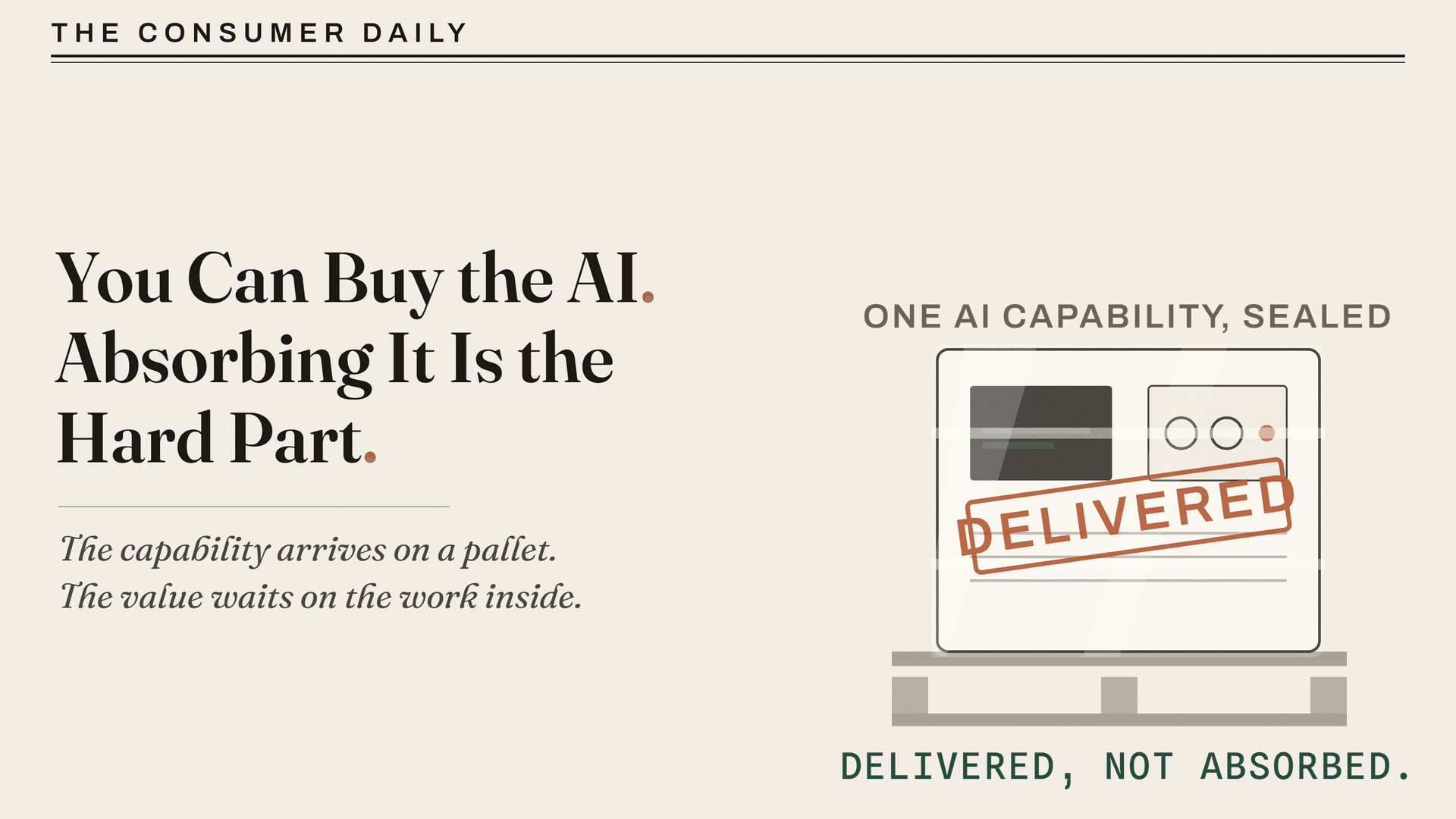
You Can Buy the AI. Absorbing It Is the Hard Part.
Every rival can buy the same AI you can, this quarter. What is left is the slow work of turning it into better decisions.
The short version
- The binding constraint in consumer goods has flipped. For a century, advantage came from acquiring capability: scale, distribution, data, analytics, now artificial intelligence (AI). Acquisition is now fast and close to a commodity. Anyone can buy the model, the revenue engine, the platform this quarter.
- So the scarce thing has moved to absorption: the slow, tacit work of rebuilding decisions, incentives, data and governance so the capability actually changes what people do and reaches the profit line. That is the one thing you cannot buy, cannot rush, and are almost certainly underfunding.
- AI does not close this gap, it widens it, because it accelerates only the half you can buy. Capability is now rising on a smooth, predictable curve, which is exactly why capability can no longer be your edge.
- We have seen this film before. Factories bought electric motors in the 1880s and waited three decades for the productivity, because the gains needed the work to be reorganised, not just the motor installed. The same lag, the productivity J-curve, is running now, faster.
- My position: stop counting what you have bought (pilots, licences, people trained) and start building and measuring what you have absorbed (the live commercial decisions AI now changes). Fund the invisible foundations first, run fewer bets with named owners, and hold your nerve through the valley, because the firm next to you that does will pull away and not come back.
- The catch most leaders miss: the economics of the technology, the psychology of your people, and the way your budget is drawn up all push the same way, toward funding the half that no longer wins.
- The worked example runs two identical companies, same tool, same spend, through three years, reconciled to the last digit, and shows the gap that absorption alone opens between them.
Why is everyone buying AI and almost nobody banking it?
Picture a brand-new machine delivered to a factory, the advanced kind a competitor would envy, still in its shrink-wrap on the loading dock. The paperwork is signed, the invoice is paid, the press release is written. Behind it, the line runs exactly as it did last year. That image is the consumer goods industry's relationship with AI right now, and the numbers say so.
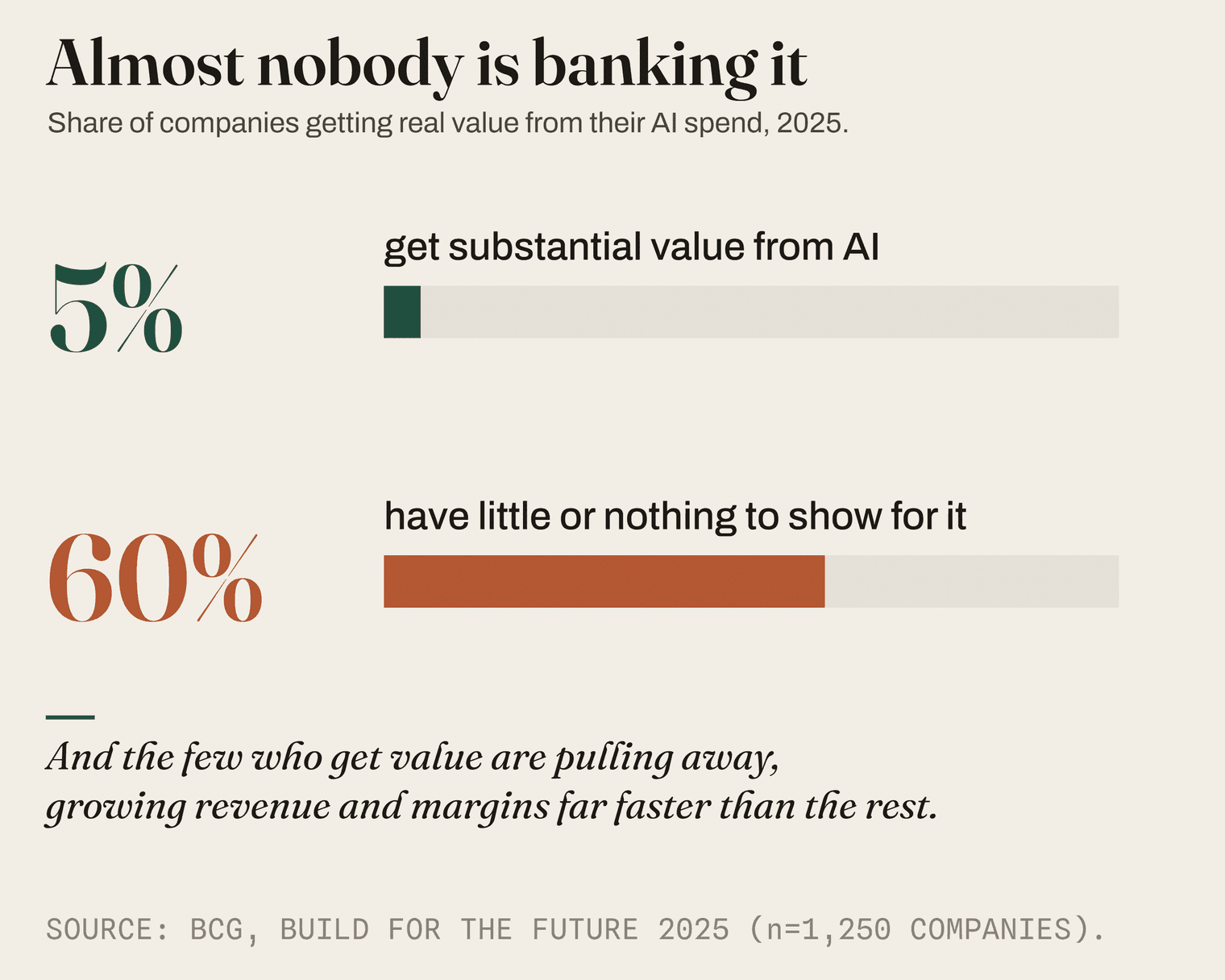
The spending is real, and the value, so far, is not. The Boston Consulting Group surveyed more than a thousand companies in 2025 and found that only 5 percent are getting substantial value from AI, while 60 percent are laggards with little or nothing to show for the money [1]. McKinsey's global survey the same year put it from the other side: only 39 percent of organisations report any impact on earnings before interest and tax (EBIT) from AI at the enterprise level, and most of those say it is under 5 percent of EBIT [2]. So almost everyone is using it, and almost no one is banking it.
The strangest part is that nobody will admit the gap. A reporter at MIT Technology Review spent weeks in late 2025 looking for a single named company that had read the failing pilots and the plateauing models and decided to pull back on AI. He could not find one [3]. Spending kept climbing while measured impact stayed absent, and the bad news changed no one's behaviour. His sharpest field note is the consultant reflex: when a pilot disappoints, executives blame the data, the speed, or the strategy. The tool is never on trial. As he put it, most of the economy is "still figuring out what the hell AI even does," not deciding whether to abandon it [3].
You can see the same gap inside the most confident companies in our industry. Coca-Cola made a public, billion-dollar commitment to generative AI, and yet by late 2025 the vast majority of its advertising was still not made with the technology [3]. That is not a criticism of Coca-Cola, which is one of the better operators at this. It is the point. The capability was bought at the top. The absorption, the rewiring of how thousands of decisions actually get made, lags years behind the cheque. This issue is about that lag: why it exists, why AI is making it worse, and what it forces you to decide.
The edge moved from buying capability to absorbing it
Here is the shift underneath all of it. For most of the history of this industry, the hard part was getting the capability. Scale was hard to build. National distribution was hard to win. A data warehouse, then an analytics team, then a machine-learning model, each was a genuine moat because it was genuinely difficult to acquire. Strategy was largely a contest of acquisition, and the company that bought or built the capability first tended to win.
That contest is over, because acquisition got easy. You can licence a world-class model this afternoon. You can buy a revenue growth management engine, a demand-forecasting system, or a media-optimisation platform off the shelf, the same one your competitor is buying. And the capability itself is now improving on a schedule. A team at MIT measured AI performance across thousands of real-world tasks and found that capability is rising as what they call a "rising tide," a smooth and predictable climb, not a series of surprise leaps [4]. When the thing that used to be your edge becomes both purchasable and predictable, it stops being an edge at all. Everyone is standing in the same rising water.
So what is left? The thing that did not get easy: turning the capability into outcomes. Economists have a precise name for this. They call it absorptive capacity, and it is the quiet hero of this whole story.
Absorptive capacity, in one box. In 1990 two researchers, Wesley Cohen and Daniel Levinthal, named a firm's ability to "recognize the value of new, external information, assimilate it, and apply it to commercial ends" [5]. Their key finding is the one that matters for AI: this capacity depends on how much related knowledge you already have, it is built up slowly, and it cannot be bought and bolted on, because the knowledge it rests on is tacit and specific to your firm. You can buy the model. You cannot buy the years of accumulated know-how that let your organisation actually use it.
The deepest evidence for my argument comes, oddly, from the people most bullish on the technology. The same MIT team that showed capability is climbing predictably writes that the open question they cannot yet answer is why adoption inside real firms lags so far behind the capability they measure in the lab, a gap they expect to take years to close [4]. Read that again. The capability researchers are telling you that capability is not the constraint. The constraint is on your side of the wall, in the absorbing, not theirs, in the building. And because AI accelerates only the half you can buy, it is pulling the two halves apart faster every quarter.
Why did electricity take thirty years to pay off?
If this feels unprecedented, it is not. It is one of the most reliable patterns in economic history, and knowing it is the difference between panic and patience.
When electric motors arrived, factories did not get more productive for about thirty years. The economist Paul David explained why: the first factories simply bolted an electric motor onto the old layout, the one built around a single central steam engine and a maze of overhead shafts and belts. The gains only came once a new generation of managers redesigned the whole factory around what electricity made possible, with a small motor on each machine and the floor laid out for the flow of work [6]. The technology was installed for three decades before it was absorbed. The lag was not stupidity. It was the time it took to reinvent how the work was done.
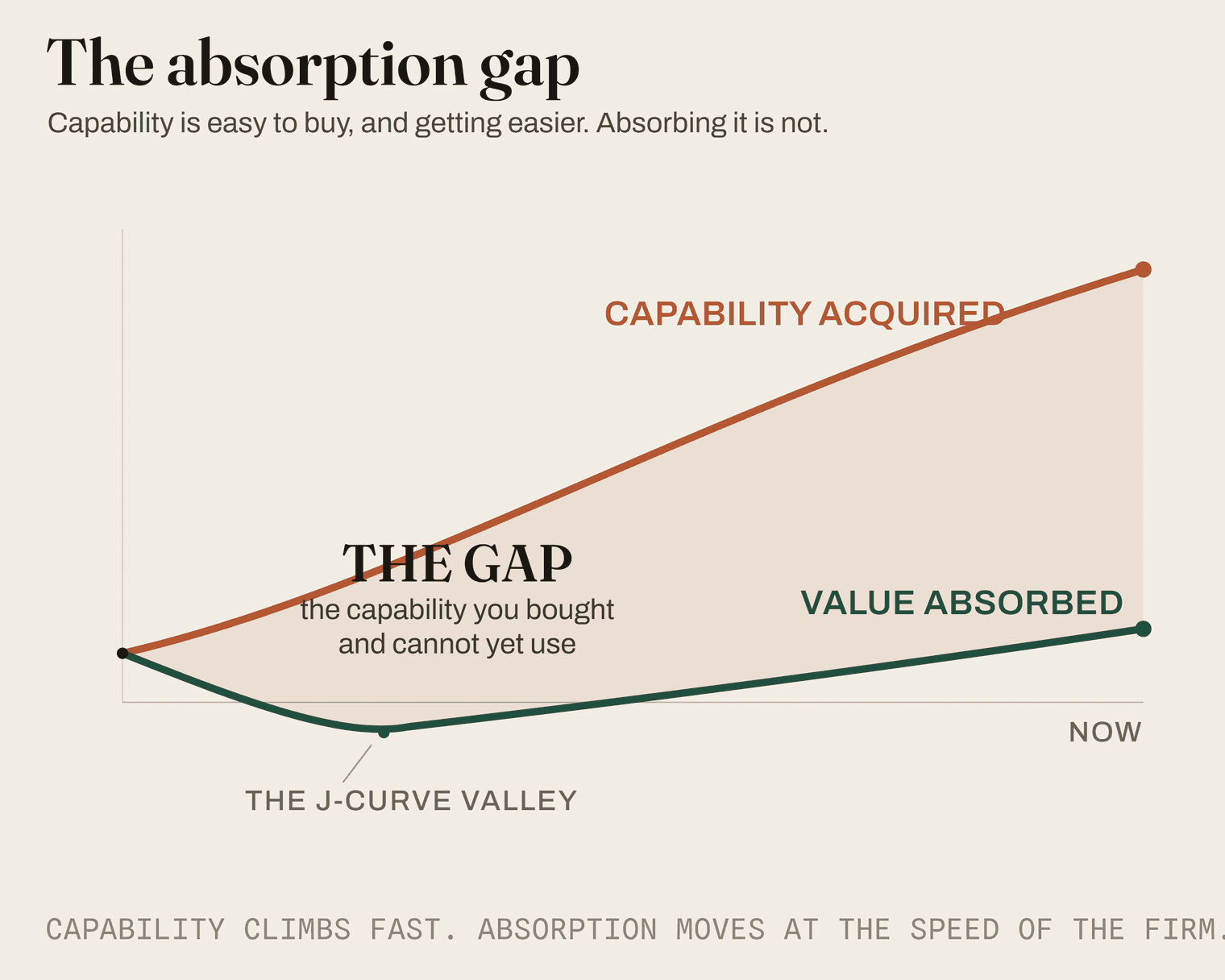
Modern economists have measured the shape of this lag and given it a name: the productivity J-curve. When a genuinely transformative technology arrives, measured productivity first dips or stalls, because the firm is pouring effort into things the accounts cannot see, new processes, retrained people, rebuilt data, redesigned work. Only later, when those invisible investments start paying off, does measured productivity bend upward into the long upstroke of the J. Erik Brynjolfsson and his colleagues found that, once you count those hidden investments, properly measured productivity was running 15.9 percent above the official figures by 2017, because so much of the value sat in intangibles the statistics missed [7]. Their most useful line for a commercial leader is the counterintuitive one: "the more transformative the new technology, the more likely its productivity effects will initially be underestimated" [7]. The bigger the prize, the longer the wait looks like failure.
This is not just a national-accounts curiosity. It happens inside individual firms, and it has now been measured in the hardest data we have. Economists working with United States Census microdata tracked tens of thousands of manufacturers through roughly 2019 to 2021 and found a causal J-curve at the company level: adopting AI lowered measured productivity at first, with the survivors recovering and pulling ahead over the following years [8]. The valley is real, the recovery is real, and the valley is exactly where nervous companies quit. They mistake the bottom of the J for proof that it does not work, and they stop digging one foot from water.
The productivity J-curve, in one box. A general-purpose technology, electricity then, AI now, makes measured productivity fall before it rises, tracing the shape of a J. The dip is not waste. It is the cost of the complementary work the technology demands: new processes, trained people, rebuilt data, redesigned jobs. National accounts and quarterly reports see the cost of that work immediately but cannot see the asset it is building, so the early years look worse than they are and the later years better. The practical lesson: if your AI programme shows a dip in year one, that may be the J-curve, not a failure. The danger is reading the valley as a verdict and cancelling the climb.
What does absorption actually look like on the shelf?
Theory is comforting, but you run a profit and loss account, so let me bring it to the shelf. In consumer goods, the gap between buying capability and absorbing it has a specific shape, and a specific price.
McKinsey, looking only at our industry, sizes the prize from a real digital and AI transformation at 5 to 15 percentage points of EBITDA margin, earnings before interest, tax, depreciation and amortisation, and then says the quiet part out loud: no consumer goods player has truly scaled its AI capabilities [10]. The prize is enormous, the tools are bought, and nobody has captured it. That is not a technology gap. It is an absorption gap.
What does the absorption actually consist of? Consider Kraft Heinz, which set out to put AI into the heart of its demand planning. The capability was the easy part. Getting the organisation to use it took years. In Kraft Heinz's own account, published by its technology supplier, the programme ran from 2019, and even then the climb from near zero to about half of its forecasts running autonomously took until early 2025, alongside double-digit gains in forecast accuracy and tens of millions of dollars of working capital freed [9]. And that is demand planning, where the output is a single number and the decision sits largely in one team. Pricing, promotion and assortment are messier, more political, and higher-stakes per call, with sales, marketing and finance all having to act on the same recommendation, so the timeline there is a floor, not a ceiling.
Revenue growth management, in one box. Revenue growth management (RGM) is the discipline of pulling a brand's commercial levers, list price, pack and price architecture, promotions, trade terms, and mix, in a coordinated way to grow profit rather than just volume. It is the part of the commercial engine where AI promises the most, because every one of those levers is a data-rich decision made thousands of times. It is also where absorption is hardest, because using it well means changing incentives, planning calendars and decision rights across sales, finance and marketing at once. RGM is both the thing AI is meant to transform and, very often, the thing that has to change for AI to land at all.
You can see the gap hiding in plain sight in how companies report their own progress. They tell you the inputs: people trained, projects launched, models deployed. Coca-Cola, again one of the more advanced, can tell you its digital media spend went from under 30 percent to over 65 percent of the total, and its own investor materials admit there is still "ample headroom" to reduce out-of-stocks and tailor offers across its outlets [11]. That headroom is the absorption gap, stated in the company's own language. The intelligence has been built. The transmission, the wiring that carries a smarter decision all the way to the shelf and the rep's next call, is the part still missing, and it is the part no licence includes.
Your people are not being difficult, they are being loss-averse
Here is where most transformation plans go wrong, because they treat adoption as a training problem. It is not. It is a psychology problem, and it is the same psychology your own brand teams use on shoppers every day, turned inward on your staff.
Think about the planner at Kraft Heinz in the early years. The company's own transformation lead named the obstacle precisely: "the friction point here was adoption. We had to ensure planners were using the tools and not falling back to Excel" [9]. Why would a trained professional, handed a better tool, revert to a spreadsheet? Because the tool threatens the thing that makes them valuable, their judgement, and people protect against a loss about twice as hard as they reach for an equivalent gain. That asymmetry, loss looming larger than gain, is loss aversion, the most reliable finding in behavioural economics, and the engine behind half the pricing tricks in this industry. Your people are not being difficult. They are running the same mental software your shoppers run, and they are reading the new system as a threat to be managed, not a gift to be used.
The proof that this is real, and not a soft excuse, is brutal and comes from that same Census study. When older, established firms adopted AI, they actually got worse at management. The researchers found that these firms let their structured management practices decay after adopting AI, and that decay alone explained about a third of their productivity loss [8]. The tool they bought to manage better had made them manage worse, because the organisation absorbed the technology by dropping the disciplines it thought it no longer needed. The capability did not just fail to land. It actively corroded the absorptive capacity that would have let it land.
So adoption has to be engineered, not assumed. The most useful framing I have seen comes from MIT Sloan, which calls the human side the "last mile" and states the whole problem in five words: application is easy, adoption is hard [12]. The fixes that work are behavioural, not technical. Earn trust with proof rather than promises, by showing people the tool's track record. Let them opt out at first, because forced adoption breeds the quiet sabotage of the reverted spreadsheet. Share the dividend, so the time a tool frees up comes back to the team as room to do better work rather than simply more work piled on. And above all, do not pave the cowpath: do not lay AI over a broken process and expect magic, because all you get is the old mess, faster [12]. Every one of those is a move to lower a perceived loss, which is to say, it is RGM aimed at your own organisation.
Why do two companies with the same tool end up miles apart?
Let me put numbers on the whole argument, because the gap between buying and absorbing is not abstract, it is cash. The figures here are illustrative, invented to show the mechanism, but they reconcile, so you can redo the arithmetic yourself.
Take two companies, call them Maker A and Maker B. They are the same size, 10 billion in revenue. In the same year they buy the same AI-powered revenue capability, and each spends the same 40 million over three years to roll it out. Same tool, same money. The only difference is that Maker A does the absorption work, redesigning how its pricing and promotion decisions actually get made, re-wiring the incentives, and fixing the data the model feeds on, while Maker B treats the tool as the project, installs it, trains people, and changes nothing else around it.
By year three, Maker A is capturing about 1.5 extra points of operating margin, the profit it keeps on each pound of sales, from better commercial decisions. On 10 billion of revenue, that is 150 million a year. Maker B, with the capability sitting in pilots and dashboards that people admire and then ignore, captures about 0.2 of a point, or 20 million. The gap is 130 million a year, on an identical 40 million of spend. Same tool, same budget, a nine-figure difference, and virtually none of it is explained by which tool they chose. It is explained by what each company did to itself around the tool.
And the gap does not stay still, it widens, which is the cruelest part. Maker A reinvests its 150 million into better data and better people, which makes the next capability absorb faster, which earns more. BCG's data shows this bifurcation already happening: the leaders are growing revenue about 1.7 times as fast as the laggards, at higher margins, and pulling away [1]. The valley of the J-curve is where the two companies separate. Maker B, staring at its disappointing year one, concludes AI does not work and slows down. Maker A keeps digging. Three years later they are not in the same league, and Maker B cannot buy its way back, because the thing it is missing was never for sale.
Why is the bill suddenly due?
For a decade, this gap was tolerated because nobody was counting. The deal between the people who funded transformation and the people who ran it was simple: approve the spend now, measure the value later. That deal is dead, and a force from outside our industry killed it.
The force is capital-markets discipline, and it arrived because the sums got too big to hide. When the largest technology companies are committing hundreds of billions to AI in a single year, the spend becomes visible in quarterly results, and investors start asking the obvious question: where is the return? The answer, so far, is thin. A late-2025 survey of finance chiefs found that only 14 percent could point to clear, measurable value from their AI spend so far [13], even as a separate survey found nearly nine in ten expected it to be very or extremely important to them the following year [14]. The gap between those two numbers is the bill coming due.
So the chief financial officer has stepped in, and the boardroom behind them. This is the year activism hit a record, with the highest number of chief executives on record pushed out within a year of a campaign [15]. The pattern is not a coincidence. When value has to be proven rather than promised, the person who speaks the language of proof takes the wheel. Gartner first forecast that 30 percent of generative-AI projects would be abandoned after the proof-of-concept stage [16], then raised that estimate to more than half by the end of 2025, and the reasons it gives are unclear business value and poor data [17]. The era of the untracked roadmap is over.
Why finance funds the tool and starves the fix, in one box. The tool arrives as a single line item, with a supplier who turns up at budget time to defend it and a contract that makes it awkward to cut. The absorption work, the training, the workflow redesign, the data cleanup, has no supplier, no single line, and no champion in the room when the budget is squeezed, so it is the first thing trimmed. Where the software is capitalised and spread over years while the change work is expensed in full this year, the bias is sharper still, but it holds even when both sit on the same profit line: the half that wins is the half nobody is paid to protect.
There is a sting in the tail, and it is the strongest argument against rushing. The same financial discipline that is healthy in principle becomes destructive if the measurement window is too short. The J-curve says the value is built in the valley, where there is nothing yet to measure. A finance chief who demands a return inside twelve months will cut exactly the long, invisible investment that was about to pay off, and will do it in the name of value realisation. The capital-markets force is real and mostly good, but used with a stopwatch it destroys the very value it is trying to protect.
So what do you do on Monday?
Three moves, and underneath them one idea: shift your attention, your money and your metrics from acquiring capability to absorbing it.
First, change what you count. Stop reporting pilots launched, licences bought and people trained, because those measure acquisition, and acquisition is the easy half that no longer wins. Start reporting absorption: in how many of your core commercial decisions, your pricing reviews, your promotion plans, your range resets, has AI actually changed the call this quarter? Put a number on it, watch it, and make it the headline metric of the programme. What you measure is what your organisation will try to move.
Second, fund the invisible foundations first, and fund fewer things. The work that makes capability land, the clean data, the redesigned decision process, the governance, is the work that is championless, because it is eighteen months of effort with no demo at the end. It is also the binding constraint, so it has to go first, not last. And resist spreading the budget across a dozen exciting use cases. The laggards in every study are the ones running the most pilots; the winners concentrate. Pick the two or three decisions that matter most, give each one a named owner who is accountable for the value reaching the profit line, and starve the rest until those land.
Third, re-incentivise the people you are asking to change, and protect the climb. If your key account managers are paid on volume, they will not adopt a tool that optimises for margin, no matter how good it is, so move their incentives before you move their tools. Share the dividend so the team that adopts is rewarded, not just asked to carry more load. And give the programme a runway measured in years, with the board's agreement up front that the J-curve valley is expected, so the first soft quarter does not trigger the cancellation that turns a temporary dip into a permanent failure. The single point to put to your own leadership: three forces, the economics of the technology, the psychology of your people, and the way the budget is drawn up, all push you to fund the half you can see and starve the half that wins. You can choose to do the opposite, but only once you have named them.
What would make me wrong?
I hold this position, but let me put the strongest case against it on the table, because a view is only worth as much as the objections it has survived.
The first objection is that agentic AI will simply remove the human bottleneck. Agentic AI is software that does not just advise but takes actions and makes decisions on its own within set limits. If it gets good enough to make and execute commercial decisions inside guardrails, then adoption, the messy human last mile, stops mattering, and absorptive capacity becomes a quaint concern. There are early signs of this, in tools that push a recommendation straight to a rep's device or run a price change automatically. I take it seriously. My answer is that someone still has to redesign the decision, set the guardrails, trust the system enough to let it run, and own the result when it is wrong, and all of that is absorption by another name. Automation moves the last mile, it does not delete it. But if guardrailed execution matures faster than I expect, say within three to four years, the balance tips, and the company that built absorptive capacity will simply have an easier time pointing the agents at the right decisions.
The second objection is more unsettling, because it uses my own evidence against me. What if the value is real but merely unmeasured, the J-curve valley rather than a true failure? In that case the firms in the trough are not failing, they are investing, and my warning to fund absorption is just describing what is already happening. This is the real tension at the centre of the piece, and I want to be straight about it: if the J-curve is real, the low value those opening surveys report could be firms sitting in the valley rather than firms failing. My response is that the valley only pays off for the ones who keep digging, and most do not. More than half of generative-AI projects are abandoned after the pilot stage rather than pushed through [17], which tells you the quitting is the real problem, not the technology. The valley rewards the diggers and buries the quitters, and what separates the two is whether they did the absorption work.
A practical caution sits underneath both. The open, well-funded route I am recommending is genuinely harder than buying a tool and declaring victory, and on a crowded agenda that cost is sometimes the deciding factor. I would put the odds that the quiet, capability-first approach keeps working at perhaps one in three for plain commodity lines, where decisions are simple and the data is clean, and considerably lower for anything where commercial judgement is complex and the data is a mess, which is to say, for most of what you sell. That is where I am willing to be wrong, and where I am betting I am not.
Signals
Five things worth your attention this week, each a piece of the same story.
- The capability clock is public. MIT researchers measuring AI across thousands of tasks find the length of job a model can handle is climbing steadily, and yet the same team names firm-level adoption, not capability, as the open problem, expecting it to lag by years. The thing you can buy is racing ahead of the thing you have to build. https://arxiv.org/abs/2604.01363
- The pilots keep dying at the same door. Gartner now estimates more than half of generative-AI projects were abandoned after the proof-of-concept stage by the end of 2025, and the reasons are unclear business value and poor data, not weak models. https://www.gartner.com/en/articles/genai-project-failure
- The finance chief is now the gate. A late-2025 survey found only 14 percent of finance leaders could point to clear, measurable value from AI so far, even as the great majority call it critical for the year ahead. Expect the business case, not the demo, to decide what survives. https://www.cfo.com/news/so-far-few-cfos-see-substantial-roi-from-ai-spending-RPG/808249/
- The tool can corrode the discipline. United States Census research finds older firms that adopted AI let their structured management practices decay, and that decay alone explained about a third of their productivity loss. Absorption is not automatic, and it can run backwards. https://www.census.gov/library/working-papers/2025/adrm/CES-WP-25-27.html
- Capability delivered, value deferred. Coca-Cola made a billion-dollar generative-AI commitment, yet the vast majority of its advertising is still not made with the technology. The cheque clears long before the absorption does. https://www.technologyreview.com/2025/10/28/1126687/an-ai-adoption-riddle/
References
- Boston Consulting Group, "The Widening AI Value Gap" (Build for the Future 2025). https://media-publications.bcg.com/The-Widening-AI-Value-Gap-Sept-2025.pdf
- McKinsey and Company, "The State of AI" (2025). https://www.mckinsey.com/capabilities/quantumblack/our-insights/the-state-of-ai
- James O'Donnell, "An AI adoption riddle," MIT Technology Review, 28 October 2025. https://www.technologyreview.com/2025/10/28/1126687/an-ai-adoption-riddle/
- Matthias Mertens, Neil Thompson and others, "Crashing Waves vs. Rising Tides: AI Automation from Worker Evaluations of Labor Market Tasks," MIT FutureTech, arXiv 2604.01363 (2026). https://arxiv.org/abs/2604.01363
- Wesley M. Cohen and Daniel A. Levinthal, "Absorptive Capacity: A New Perspective on Learning and Innovation," Administrative Science Quarterly, 35(1), 1990. https://www.jstor.org/stable/2393553
- Tom Relihan, "A calm before the AI productivity storm" (on research by Brynjolfsson, Rock and Syverson), MIT Sloan, 2019. https://mitsloan.mit.edu/ideas-made-to-matter/a-calm-ai-productivity-storm
- Erik Brynjolfsson, Daniel Rock and Chad Syverson, "The Productivity J-Curve: How Intangibles Complement General Purpose Technologies," NBER Working Paper 25148 (2018, revised 2020). https://www.nber.org/papers/w25148
- Kristina McElheran, Mu-Jeung Yang, Zachary Kroff and Erik Brynjolfsson, "The Rise of Industrial AI in America: Microfoundations of the Productivity J-curve(s)," US Census Bureau CES Working Paper 25-27 (2025). https://www.census.gov/library/working-papers/2025/adrm/CES-WP-25-27.html
- o9 Solutions, "How Kraft Heinz is using AI to transform demand planning" (2025). https://o9solutions.com/articles/how-is-kraft-heinz-using-ai-to-transform-demand-planning
- McKinsey and Company, "Fortune or fiction: The real value of a digital and AI transformation in CPG" (October 2024). https://www.mckinsey.com/industries/consumer-packaged-goods/our-insights/fortune-or-fiction-the-real-value-of-a-digital-and-ai-transformation-in-cpg
- The Coca-Cola Company, Investor Relations, "Growth Strategy" (2025). https://investors.coca-colacompany.com/about/growth-strategy
- Peter Hirst, "Beyond the Algorithm: Bridging the Last Mile of AI Adoption," MIT Sloan Executive Education (2025). https://executive.mit.edu/blog/beyond-the-algorithm-bridging-the-last-mile-of-ai-adoption.html
- RGP, "So far, few CFOs see substantial ROI from AI spending" (reported by CFO.com, December 2025). https://www.cfo.com/news/so-far-few-cfos-see-substantial-roi-from-ai-spending-RPG/808249/
- Deloitte, "Q4 2025 CFO Signals Survey" (December 2025). https://www.deloitte.com/us/en/about/press-room/deloitte-q4-2025-cfo-signals-survey.html
- Harvard Law School Forum on Corporate Governance, "2025 Shareholder Activism Trends and What to Expect in 2026" (February 2026). https://corpgov.law.harvard.edu/2026/02/01/2025-shareholder-activism-trends-and-what-to-expect-in-2026/
- Gartner, "Gartner Predicts 30% of Generative AI Projects Will Be Abandoned After Proof of Concept by End of 2025" (July 2024). https://www.gartner.com/en/newsroom/press-releases/2024-07-29-gartner-predicts-30-percent-of-generative-ai-projects-will-be-abandoned-after-proof-of-concept-by-end-of-2025
- Gartner, "GenAI project failure: why generative AI projects stall" (2026). https://www.gartner.com/en/articles/genai-project-failure