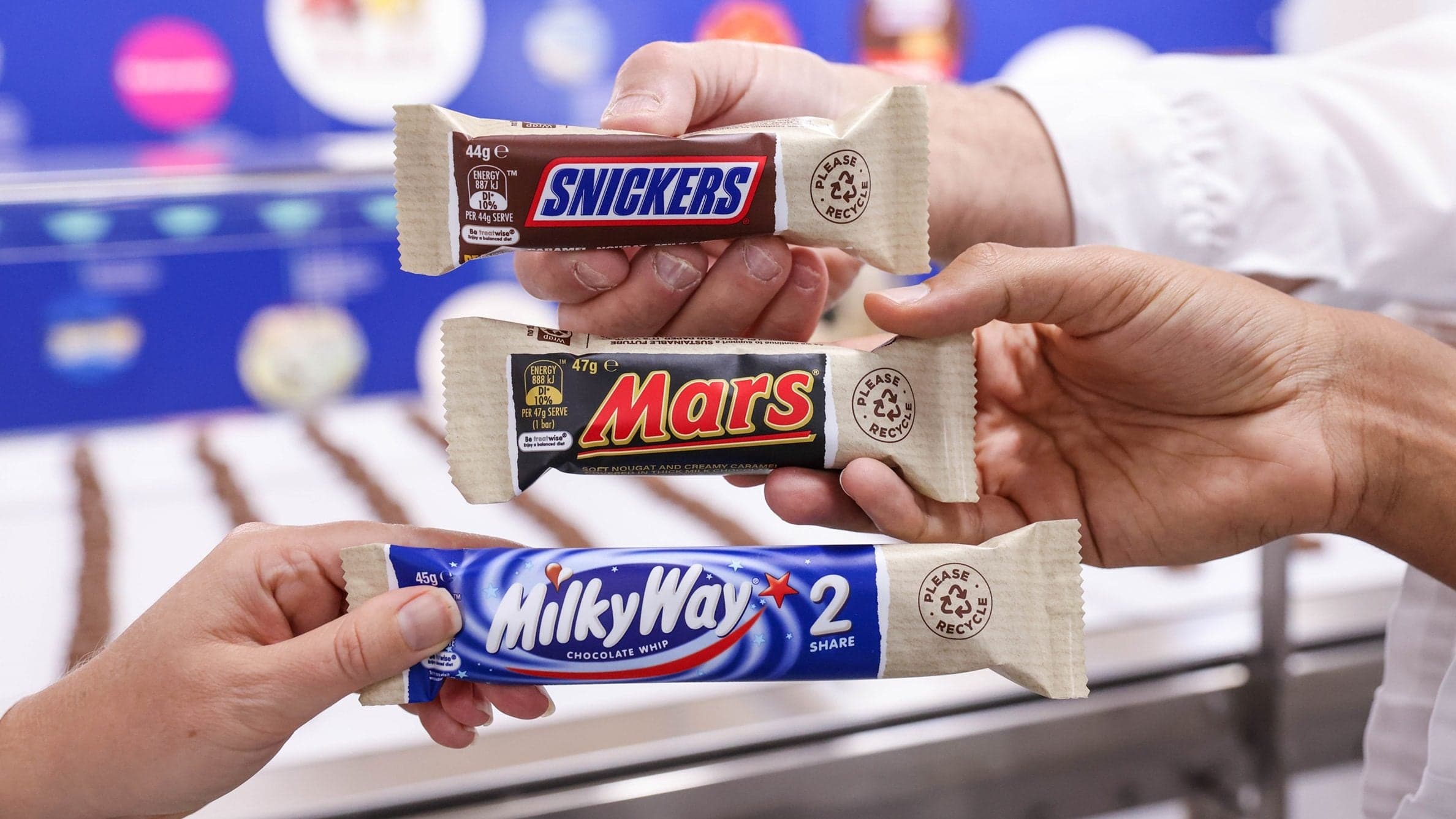
The world's largest confectioners are struggling to meet their own voluntary plastic reduction targets. Mars, Mondelez, Ferrero and Nestlé have all fallen short, according to 2024 data from the Ellen MacArthur Foundation published at the end of last year.
Mars carries 49% of its packaging in flexible plastics. At Ferrero it is 25%, and at Mondelez 68%. These materials are nearly impossible to recycle back into food-grade plastic, so paper-based alternatives are attracting investment and regulatory support.
The 95/5 rule reshapes packaging
The EU's packaging and packaging waste regulation (PPWR) now allows packaging that is 95% paper and no more than 5% plastic. This threshold is crucial because it means such wrapping can be recycled through existing paper streams rather than as plastic waste.
Coveris, a packaging producer, recently announced a paper-plastic wrapper that works on existing high-speed form-fill-seal (FFS) machinery with no major modifications needed. Last month, Coveris and Nextek began industrial-scale trials in the UK to convert post-consumer polyolefin film waste into recycled resin, though regulators will require two years of data before approving it for food contact.
Progress is uneven
Mondelez reported an 11.5% reduction in virgin plastic for 2025, beating its 5% target. But its use of post-consumer recycled plastic (PCR) stands at just 3.7%. Ferrero managed 5.8%, Nestlé 14.7% and Mars 7%, making the switch to recycled content more difficult than reducing virgin plastic alone.
The company has extended its packaging targets from 2025 to 2030, citing "rapidly evolving regulations, changing consumer and customer needs, the complexity of implementing novel packaging solutions across a complex global network and the slower-than-anticipated scaling of circular systems."
Deforestation and sourcing risks
Paper's momentum raises a forest problem. Nestlé's non-financial statement warns of "the risk of contributing to deforestation through new sourcing practices" as it shifts toward paper-based packaging. Tallulah Chapman from the Forest Stewardship Council notes that "whether forests can keep up with demand for paper is a complex issue, particularly as demand for many kinds of wood-derived products is growing."
Responsible sourcing matters. Alter Eco's paper-based chocolate packaging, launched with Amcor in February, carries FSC certification. But without certification standards, paper can become a greenwashing story rather than a genuine environmental gain.
Cost and perception gaps
A GlobalData survey across 42 countries found that a quarter of consumers see recyclable packaging as essential and nearly half as a nice-to-have. This perception drives momentum, but confectionery brands face a friction: paper wrappers change the sensorial experience that drives purchase in a category built on crinkle, ease of opening and resealability.
Patrick Young at PRS In Vivo notes that "in a category like confectionery, where purchase decisions are fast and emotionally driven" the visual signal of paper is powerful, but the experience can disappoint. Paper-based wrapping alters the tactile feedback that consumers expect.
The Middle East conflict has also tightened margins. Polyethylene and polypropylene prices hit four-year highs following disruptions through the Strait of Hormuz, pushing some brands toward paper. Mondi, a major packaging producer, announced price rises later this year due to "challenging market conditions" and "cost pressures linked to escalating political tensions."
A simpler answer remains elusive
Nicole Rycroft, executive director of Canopy, warns brands against jumping "from the plastics frying pan into the paper fire" without ensuring responsible sourcing and local recycling infrastructure. Flexible plastic packaging accounts for 80% of plastic entering oceans, particularly affecting countries like India and Indonesia where collection systems are weak.
Kara Brown of Bee Inspired, an artisan US confectionery maker, raises a sharper question: "The real question is whether switching from plastic to paper-plastic composites truly helps the environment, or if it just protects the brand's reputation." Research on reuse and refill systems shows consumer willingness, but uptake across consumer goods remains minimal. Confectionery brands are caught between cutting plastic, protecting forests and preserving the wrapper experience that drives sales.